Ch. 7 - Applications of Trigonometry and Vectors
Lial - Trigonometry 12th Edition
Lial12th EditionTrigonometryISBN: 9780136552161Not the one you use?Change textbook
Chapter 8, Problem 19

For each pair of vectors u and v with angle θ between them, sketch the resultant.


|u| = 12, |v| = 20, θ = 27°

Verified step by step guidance
1
Identify the given information: the magnitudes of vectors \( \mathbf{u} \) and \( \mathbf{v} \) are \( |\mathbf{u}| = 12 \) and \( |\mathbf{v}| = 20 \), and the angle between them is \( \theta = 27^\circ \).
Recall that the resultant vector \( \mathbf{R} = \mathbf{u} + \mathbf{v} \) can be found using the Law of Cosines for vectors, where the magnitude of \( \mathbf{R} \) is given by: \[ |\mathbf{R}| = \sqrt{|\mathbf{u}|^2 + |\mathbf{v}|^2 + 2 |\mathbf{u}| |\mathbf{v}| \cos(\theta)} \]
To sketch the resultant, start by drawing vector \( \mathbf{u} \) with length proportional to 12 units in any direction you choose.
Next, from the tip of \( \mathbf{u} \), draw vector \( \mathbf{v} \) at an angle of \( 27^\circ \) relative to \( \mathbf{u} \), with length proportional to 20 units.
The resultant vector \( \mathbf{R} \) is then drawn from the tail of \( \mathbf{u} \) (the starting point) to the tip of \( \mathbf{v} \) (the ending point). This vector represents the sum \( \mathbf{u} + \mathbf{v} \).

Verified video answer for a similar problem:

This video solution was recommended by our tutors as helpful for the problem above.
Was this helpful?

Key Concepts

Here are the essential concepts you must grasp in order to answer the question correctly.

Vector Addition

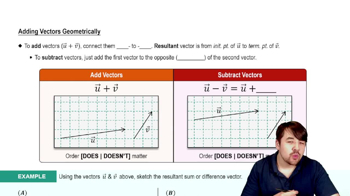
Vector addition involves combining two vectors to find their resultant by placing them head-to-tail and drawing the vector from the start of the first to the end of the second. This graphical method helps visualize the resultant vector's magnitude and direction.
Recommended video:
05:29
Adding Vectors Geometrically

Law of Cosines for Vectors

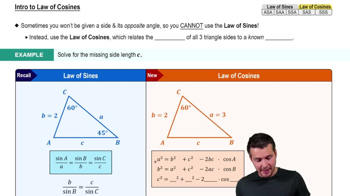
The Law of Cosines relates the magnitudes of two vectors and the angle between them to find the magnitude of their resultant: |R| = √(|u|² + |v|² + 2|u||v|cosθ). This formula is essential for calculating the exact length of the resultant vector.
Recommended video:
4:35
Intro to Law of Cosines

Angle Between Vectors

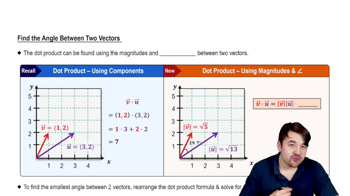
The angle θ between two vectors determines how they combine. It affects both the magnitude and direction of the resultant vector, influencing whether the vectors reinforce or partially cancel each other.
Recommended video:
04:33
Find the Angle Between Vectors