Ch. 7 - Applications of Trigonometry and Vectors
Lial - Trigonometry 12th Edition
Lial12th EditionTrigonometryISBN: 9780136552161Not the one you use?Change textbook
Chapter 8, Problem 21

For each pair of vectors u and v with angle θ between them, sketch the resultant.


|u| = 20, |v| = 30, θ = 30°

Verified step by step guidance
1
Identify the given information: the magnitudes of vectors \( \mathbf{u} \) and \( \mathbf{v} \) are \( |\mathbf{u}| = 20 \) and \( |\mathbf{v}| = 30 \), and the angle between them is \( \theta = 30^\circ \).
Recall that the resultant vector \( \mathbf{r} = \mathbf{u} + \mathbf{v} \) can be found using the law of cosines for vectors, where the magnitude of \( \mathbf{r} \) is given by: \[ \\|\mathbf{r}\\\| = \sqrt{ |\mathbf{u}|^2 + |\mathbf{v}|^2 + 2 |\mathbf{u}| |\mathbf{v}| \cos(\theta) } \]
To sketch the resultant, start by drawing vector \( \mathbf{u} \) as an arrow of length 20 units in any direction.
Next, from the tip of \( \mathbf{u} \), draw vector \( \mathbf{v} \) at an angle of \( 30^\circ \) relative to \( \mathbf{u} \), with length 30 units.
The resultant vector \( \mathbf{r} \) is represented by the arrow drawn from the tail of \( \mathbf{u} \) to the tip of \( \mathbf{v} \). This completes the vector addition and visually shows the resultant.

Verified video answer for a similar problem:

This video solution was recommended by our tutors as helpful for the problem above.
Was this helpful?

Key Concepts

Here are the essential concepts you must grasp in order to answer the question correctly.

Vector Magnitude and Direction

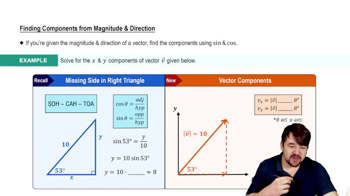
A vector is defined by its magnitude (length) and direction. Understanding how to represent vectors graphically involves drawing arrows with lengths proportional to their magnitudes and angles corresponding to their directions. This is essential for accurately sketching vectors u and v with given magnitudes and the angle θ between them.
Recommended video:
04:55
Finding Components from Direction and Magnitude

Angle Between Vectors

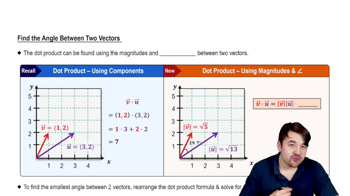
The angle θ between two vectors is the measure of the smallest rotation from one vector to the other. It determines how the vectors are oriented relative to each other and affects the resultant vector's magnitude and direction when the vectors are added.
Recommended video:
04:33
Find the Angle Between Vectors

Vector Addition and Resultant Vector

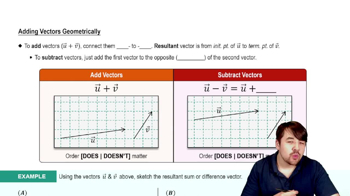
The resultant vector is found by adding two vectors head-to-tail, combining their magnitudes and directions. Using the law of cosines or parallelogram method, the magnitude and direction of the resultant can be determined, which is crucial for sketching the resultant vector from u and v with a known angle θ.
Recommended video:
05:29
Adding Vectors Geometrically