Ch. 7 - Applications of Trigonometry and Vectors
Lial - Trigonometry 12th Edition
Lial12th EditionTrigonometryISBN: 9780136552161Not the one you use?Change textbook
Chapter 8, Problem 47

Starting at point A, a ship sails 18.5 km on a bearing of 189°, then turns and sails 47.8 km on a bearing of 317°. Find the distance of the ship from point A.

Verified step by step guidance
1
Understand the problem: The ship starts at point A, sails 18.5 km on a bearing of 189°, then changes direction and sails 47.8 km on a bearing of 317°. We need to find the straight-line distance from the final position back to point A.
Convert the bearings into standard angles relative to the positive x-axis (east direction). Bearings are measured clockwise from north, so to convert a bearing \( \theta_b \) to an angle \( \theta \) from the positive x-axis, use \( \theta = 90° - \theta_b \). Adjust the angle to be between 0° and 360° if necessary.
Calculate the coordinates of the ship after each leg of the journey using trigonometry: For each leg, the change in x (east-west) is \( \Delta x = d \times \cos(\theta) \) and the change in y (north-south) is \( \Delta y = d \times \sin(\theta) \), where \( d \) is the distance sailed and \( \theta \) is the angle from the positive x-axis.
Sum the x and y components from both legs to find the final coordinates \( (x, y) \) of the ship relative to point A.
Use the distance formula to find the straight-line distance from point A to the final position: \[ \text{Distance} = \sqrt{x^2 + y^2} \].

Verified video answer for a similar problem:

This video solution was recommended by our tutors as helpful for the problem above.
Was this helpful?

Key Concepts

Here are the essential concepts you must grasp in order to answer the question correctly.

Bearings and Direction

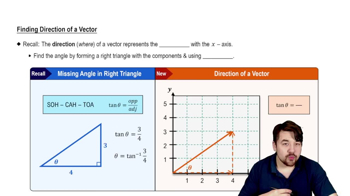
Bearings are angles measured clockwise from the north direction to indicate direction. Understanding how to interpret bearings like 189° and 317° is essential for plotting the ship's path relative to the starting point.
Recommended video:
05:13
Finding Direction of a Vector

Vector Representation of Displacement

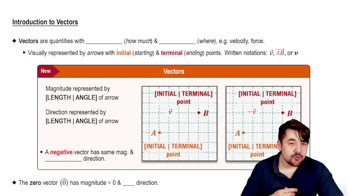
Each leg of the ship's journey can be represented as a vector with magnitude (distance sailed) and direction (bearing). Converting these vectors into components allows for the calculation of the resultant displacement from the starting point.
Recommended video:
03:48
Introduction to Vectors

Distance Calculation Using the Pythagorean Theorem or Law of Cosines

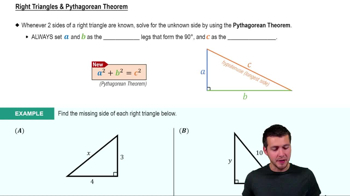
After determining the resultant vector components or the angle between legs, the distance from the starting point can be found using the Pythagorean theorem for perpendicular components or the Law of Cosines for non-right triangles.
Recommended video:
5:19
Solving Right Triangles with the Pythagorean Theorem