Starting at point A, a ship sails 18.5 km on a bearing of 189°, then turns and sails 47.8 km on a bearing of 317°. Find the distance of the ship from point A.
Ch. 7 - Applications of Trigonometry and Vectors
Chapter 8, Problem 46
Write each vector in the form a i + b j.
〈6, -3〉
Verified step by step guidance1
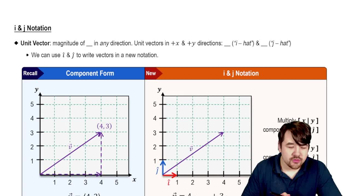
Understand that the vector given in angle bracket notation 〈x, y〉 can be expressed in terms of unit vectors \( \mathbf{i} \) and \( \mathbf{j} \), where \( \mathbf{i} \) is the unit vector in the x-direction and \( \mathbf{j} \) is the unit vector in the y-direction.
Identify the components of the vector: here, the x-component is 6 and the y-component is -3.
Write the vector as a linear combination of the unit vectors: multiply the x-component by \( \mathbf{i} \) and the y-component by \( \mathbf{j} \).
Express the vector as \( 6\mathbf{i} + (-3)\mathbf{j} \).
Simplify the expression by writing it as \( 6\mathbf{i} - 3\mathbf{j} \), which is the vector in the form \( a\mathbf{i} + b\mathbf{j} \).

Verified video answer for a similar problem:
This video solution was recommended by our tutors as helpful for the problem above.
Was this helpful?
Key Concepts
Here are the essential concepts you must grasp in order to answer the question correctly.
Vector Representation in Component Form
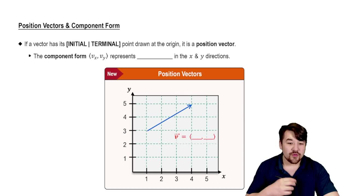
A vector in two dimensions can be expressed as a combination of its horizontal and vertical components. These components correspond to the vector's projections along the x-axis and y-axis, respectively, and are typically written as a multiple of unit vectors i (x-direction) and j (y-direction).
Recommended video:
Position Vectors & Component Form
Unit Vectors i and j
Unit vectors i and j are standard basis vectors in the plane, where i represents a vector of length one in the positive x-direction, and j represents a vector of length one in the positive y-direction. Any 2D vector can be written as a linear combination of i and j.
Recommended video:
i & j Notation
Converting Coordinate Notation to Vector Form
Given a vector in coordinate form 〈x, y〉, it can be rewritten as x i + y j by multiplying the x-component by i and the y-component by j. This form clearly shows the vector's direction and magnitude along each axis.
Recommended video:
Position Vectors & Component Form
Related Practice
Textbook Question
Textbook Question
Given vectors u and v, find: v - 3u.
u = 〈-1, 2〉, v = 〈3, 0〉
Textbook Question
A ship leaves port on a bearing of 34.0° and travels 10.4 mi. The ship then turns due east and travels 4.6 mi. How far is the ship from port, and what is its bearing from port?
Textbook Question
A luxury liner leaves port on a bearing of 110.0° and travels 8.8 mi. It then turns due west and travels 2.4 mi. How far is the liner from port, and what is its bearing from port?
6
views
Textbook Question
Write each vector in the form a i + b j.
〈2, 0〉
Textbook Question
A crate is supported by two ropes. One rope makes an angle of 46° 20′ with the horizontal and has a tension of 89.6 lb on it. The other rope is horizontal. Find the weight of the crate and the tension in the horizontal rope.