Ch. 7 - Applications of Trigonometry and Vectors
Lial - Trigonometry 12th Edition
Lial12th EditionTrigonometryISBN: 9780136552161Not the one you use?Change textbook
Chapter 8, Problem 35

A force of 176 lb makes an angle of 78° 50′ with a second force. The resultant of the two forces makes an angle of 41° 10′ with the first force. Find the magnitudes of the second force and of the resultant.


<IMAGE>

Verified step by step guidance
1
Convert all given angles from degrees and minutes to decimal degrees for easier calculation. For example, 78° 50′ becomes 78 + 50/60 degrees, and similarly for 41° 10′.
Label the forces: let the first force be \( F_1 = 176 \) lb, the second force be \( F_2 \), and the resultant force be \( R \). The angle between \( F_1 \) and \( F_2 \) is \( \theta = 78.8333^\circ \) (converted from 78° 50′), and the angle between \( F_1 \) and \( R \) is \( \alpha = 41.1667^\circ \) (converted from 41° 10′).
Use the Law of Cosines to express the magnitude of the resultant force \( R \) in terms of \( F_1 \), \( F_2 \), and \( \theta \): \[ R^2 = F_1^2 + F_2^2 + 2 F_1 F_2 \cos(\theta) \]
Use the Law of Sines or the formula for the angle between two vectors to relate the given angle \( \alpha \) to the forces. Specifically, use the formula for the tangent of the angle between \( F_1 \) and \( R \): \[ \tan(\alpha) = \frac{F_2 \sin(\theta)}{F_1 + F_2 \cos(\theta)} \] This equation allows you to solve for \( F_2 \).
Solve the equation from step 4 for \( F_2 \), then substitute \( F_2 \) back into the Law of Cosines equation from step 3 to find the magnitude of the resultant force \( R \).

Verified video answer for a similar problem:

This video solution was recommended by our tutors as helpful for the problem above.
Was this helpful?

Key Concepts

Here are the essential concepts you must grasp in order to answer the question correctly.

Vector Addition of Forces

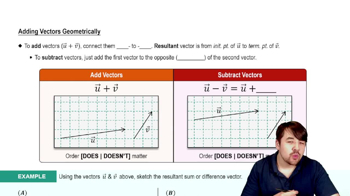
When two forces act at an angle, their combined effect is found by vector addition. The resultant force is the vector sum of the individual forces, and its magnitude and direction depend on both the magnitudes and the angle between the forces.
Recommended video:
05:29
Adding Vectors Geometrically

Law of Cosines

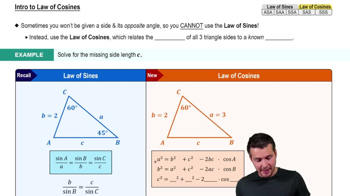
The Law of Cosines relates the lengths of sides of a triangle to the cosine of one of its angles. It is used to find the magnitude of the resultant force when two forces and the angle between them are known, or to find an unknown force when the resultant and angles are given.
Recommended video:
4:35
Intro to Law of Cosines

Law of Sines

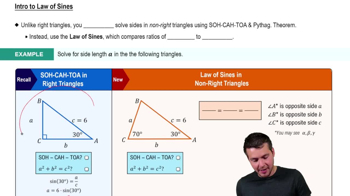
The Law of Sines relates the ratios of the lengths of sides of a triangle to the sines of their opposite angles. It helps determine unknown angles or side lengths in the force triangle, especially when the resultant's angle relative to one force is given.
Recommended video:
4:27
Intro to Law of Sines