Ch. 7 - Applications of Trigonometry and Vectors
Lial - Trigonometry 12th Edition
Lial12th EditionTrigonometryISBN: 9780136552161Not the one you use?Change textbook
Chapter 8, Problem 34

Apply the law of sines to the following:


A = 104°, a = 26.8, b = 31.3.


What happens when we try to find the measure of angle B using a calculator?

Verified step by step guidance
1
Recall the Law of Sines formula: \(\frac{a}{\sin A} = \frac{b}{\sin B}\), where \(A\) and \(B\) are angles opposite sides \(a\) and \(b\) respectively.
Substitute the known values into the formula: \(\frac{26.8}{\sin 104^\circ} = \frac{31.3}{\sin B}\).
Rearrange the equation to solve for \(\sin B\): \(\sin B = \frac{31.3 \times \sin 104^\circ}{26.8}\).
Use a calculator to evaluate the right-hand side expression to find the numerical value of \(\sin B\).
Observe the result: if the value of \(\sin B\) is greater than 1, this indicates that no angle \(B\) exists with such a sine value, meaning the triangle cannot be formed with the given measurements.

Verified video answer for a similar problem:

This video solution was recommended by our tutors as helpful for the problem above.
Was this helpful?

Key Concepts

Here are the essential concepts you must grasp in order to answer the question correctly.

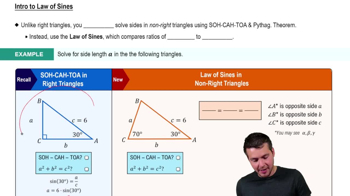
Law of Sines

The Law of Sines relates the ratios of the lengths of sides of a triangle to the sines of their opposite angles: (a/sin A) = (b/sin B) = (c/sin C). It is used to find unknown sides or angles in any triangle when given sufficient information, especially in non-right triangles.
Recommended video:
4:27
Intro to Law of Sines

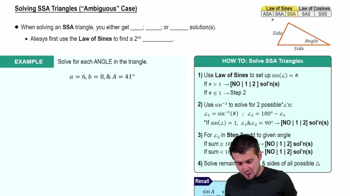
Ambiguous Case in the Law of Sines

When using the Law of Sines to find an angle, the inverse sine function can yield two possible angle measures (an acute and an obtuse angle) because sin(θ) = sin(180° - θ). This ambiguity can cause confusion or multiple solutions, especially in SSA (Side-Side-Angle) configurations.
Recommended video:
9:50
Solving SSA Triangles ("Ambiguous" Case)

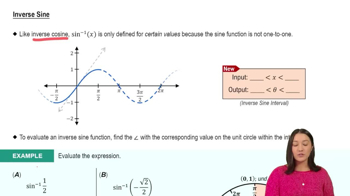
Using a Calculator for Inverse Sine

Calculators typically return the principal value of the inverse sine function, which is an angle between -90° and 90°. When solving triangles, this means the calculator gives only one possible angle, so you must consider the possibility of a second valid angle (180° minus the calculator’s result) to fully solve the problem.
Recommended video:
4:03
Inverse Sine