Ch. 7 - Applications of Trigonometry and Vectors
Lial - Trigonometry 12th Edition
Lial12th EditionTrigonometryISBN: 9780136552161Not the one you use?Change textbook
Chapter 8, Problem 35

A ship is sailing due north. At a certain point the bearing of a lighthouse 12.5 km away is N 38.8° E. Later on, the captain notices that the bearing of the lighthouse has become S 44.2° E. How far did the ship travel between the two observations of the lighthouse?

Verified step by step guidance
1
Draw a diagram to visualize the problem: mark the lighthouse as a fixed point, and the ship's two positions as points along a northward path. Label the bearings from each ship position to the lighthouse accordingly.
Convert the bearings into angles relative to the north-south line. For the first position, the bearing N 38.8° E means the lighthouse is 38.8° east of north. For the second position, S 44.2° E means the lighthouse is 44.2° east of south.
Set up a coordinate system with the ship's path along the y-axis (north direction). Place the lighthouse at the origin for convenience, and express the positions of the ship at the two observations using trigonometric relations based on the given distances and angles.
Use the law of sines or law of cosines in the triangle formed by the lighthouse and the two ship positions to find the distance between the two ship positions. This distance represents how far the ship traveled between the two observations.
Write the formula for the distance between the two ship positions in terms of the known distances and angles, and simplify it to an expression that can be evaluated to find the ship's traveled distance.

Verified video answer for a similar problem:

This video solution was recommended by our tutors as helpful for the problem above.
Was this helpful?

Key Concepts

Here are the essential concepts you must grasp in order to answer the question correctly.

Bearings and Directional Angles

Bearings describe direction relative to the north or south line, measured clockwise. For example, N 38.8° E means 38.8 degrees east of due north. Understanding how to interpret and convert these bearings into angles for calculations is essential for solving navigation problems.
Recommended video:
05:13
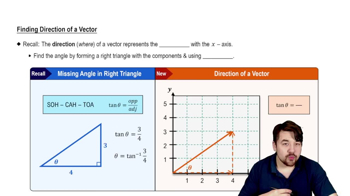
Finding Direction of a Vector

Triangle Formation and Law of Cosines

The positions of the ship and lighthouse form a triangle when the ship changes position. The Law of Cosines relates the lengths of sides to the cosine of an included angle, allowing calculation of unknown distances when two sides and the included angle are known.
Recommended video:
4:35
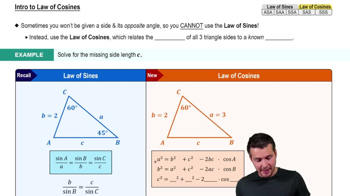
Intro to Law of Cosines

Relative Motion and Distance Calculation

As the ship moves north, the change in bearing to the lighthouse reflects a change in relative position. Calculating the distance traveled involves analyzing how the ship’s movement affects the triangle’s sides and angles, enabling determination of the ship’s displacement between observations.
Recommended video:
4:30
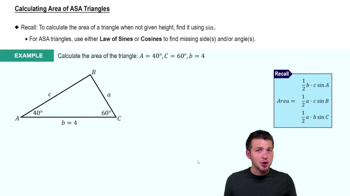
Calculating Area of ASA Triangles