Ch. 7 - Applications of Trigonometry and Vectors
Lial - Trigonometry 12th Edition
Lial12th EditionTrigonometryISBN: 9780136552161Not the one you use?Change textbook
Chapter 8, Problem 41

A force of 18.0 lb is required to hold a 60.0-lb stump grinder on an incline. What angle does the incline make with the horizontal?

Verified step by step guidance
1
Identify the forces acting on the stump grinder on the incline: the weight (60.0 lb) acting vertically downward and the force (18.0 lb) required to hold it in place along the incline.
Recognize that the force holding the grinder is balancing the component of the weight parallel to the incline. The weight can be resolved into two components: one parallel to the incline and one perpendicular to it.
Use the relationship between the force parallel to the incline and the angle \( \theta \) of the incline: the parallel component of the weight is given by \( W \sin(\theta) \), where \( W = 60.0 \) lb.
Set up the equation equating the force required to hold the grinder to the parallel component of the weight: \( 18.0 = 60.0 \sin(\theta) \).
Solve for the angle \( \theta \) by isolating \( \sin(\theta) \): \( \sin(\theta) = \frac{18.0}{60.0} \), then find \( \theta = \arcsin\left(\frac{18.0}{60.0}\right) \).

Verified video answer for a similar problem:

This video solution was recommended by our tutors as helpful for the problem above.
Was this helpful?

Key Concepts

Here are the essential concepts you must grasp in order to answer the question correctly.

Forces on an Inclined Plane

When an object rests on an inclined plane, its weight can be resolved into components parallel and perpendicular to the plane. The parallel component causes the object to slide down, while the perpendicular component presses it against the surface. Understanding these components is essential to analyze forces acting on the object.
Recommended video:
3:22
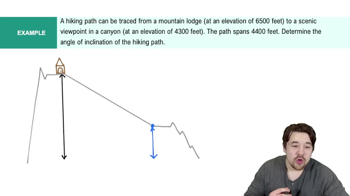
Example 2

Trigonometric Resolution of Forces

Trigonometry allows us to relate the angle of the incline to the force components using sine and cosine functions. Specifically, the component of weight parallel to the incline is given by weight times sine of the angle, and the perpendicular component by weight times cosine of the angle.
Recommended video:
5:32
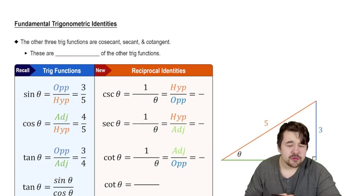
Fundamental Trigonometric Identities

Equilibrium and Force Balance

For the stump grinder to be held stationary, the applied force must balance the component of weight pulling it down the incline. Setting the applied force equal to the parallel component of weight allows solving for the incline angle, ensuring the system is in equilibrium.
Recommended video:
04:39
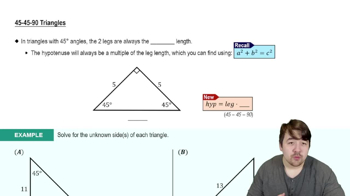
45-45-90 Triangles