Back
Back
Problem 9
Determine the number of triangles ABC possible with the given parts.
c = 50, b = 61, C = 58°
Problem 11
Find each angle B. Do not use a calculator.
<IMAGE>
Problem 13
Find the unknown angles in triangle ABC for each triangle that exists.
A = 29.7°, b = 41.5 ft, a = 27.2 ft
Problem 15
Find the unknown angles in triangle ABC for each triangle that exists.
C = 41° 20', b = 25.9 m, c = 38.4 m
Problem 17
Find the unknown angles in triangle ABC for each triangle that exists.
B = 74.3°, a = 859 m, b = 783 m
Problem 21
Solve each triangle ABC that exists.
A = 42.5°, a = 15.6 ft, b = 8.14 ft
Problem 23
Solve each triangle ABC that exists.
B = 72.2°, b = 78.3 m, c = 145 m
Problem 25
Solve each triangle ABC that exists.
A = 38° 40', a = 9.72 m, b = 11.8 m
Problem 29
Solve each triangle ABC that exists.
B = 39.68°, a = 29.81 m, b = 23.76 m
Problem 31
Apply the law of sines to the following: a = √5, c = 2√5, A = 30°. What is the value of sin C? What is the measure of C? Based on its angle measures, what kind of triangle is triangle ABC?
Problem 33
Without using the law of sines, explain why no triangle ABC can exist that satisfies A = 103° 20', a = 14.6 ft, b = 20.4 ft.
Problem 34
Apply the law of sines to the following:
A = 104°, a = 26.8, b = 31.3.
What happens when we try to find the measure of angle B using a calculator?
Problem 40
Use the law of sines to prove that each statement is true for any triangle ABC, with corresponding sides a, b, and c.
(a - b)/(a + b) = (sin A - sin B)/(sin A + sin B)
Problem 63
Find the exact area of each triangle using the formula 𝓐 = ½ bh, and then verify that Heron's formula gives the same result.
<IMAGE>
Problem 1
CONCEPT PREVIEW Assume a triangle ABC has standard labeling.
a. Determine whether SAA, ASA, SSA, SAS, or SSS is given.
b. Determine whether the law of sines or the law of cosines should be used to begin solving the triangle.
a, b, and C
Problem 4
CONCEPT PREVIEW Assume a triangle ABC has standard labeling.
a. Determine whether SAA, ASA, SSA, SAS, or SSS is given.
b. Determine whether the law of sines or the law of cosines should be used to begin solving the triangle.
a, B, and C
Problem 9
Find the length of the remaining side of each triangle. Do not use a calculator.
<IMAGE>
Problem 13
Solve each triangle. Approximate values to the nearest tenth.
<IMAGE>
Problem 15
Solve each triangle. Approximate values to the nearest tenth.
<IMAGE>
Problem 18
Solve each triangle. Approximate values to the nearest tenth.
<IMAGE>
Problem 19
Solve each triangle. See Examples 2 and 3.
A = 41.4°, b = 2.78 yd, c = 3.92 yd
Problem 23
Solve each triangle. See Examples 2 and 3.
a = 9.3 cm, b = 5.7 cm, c = 8.2 cm
Problem 25
Solve each triangle. See Examples 2 and 3.
a = 42.9 m, b = 37.6 m, c = 62.7 m
Problem 27
Solve each triangle. See Examples 2 and 3.
a = 965 ft, b = 876 ft, c = 1240 ft
Problem 29
Solve each triangle. See Examples 2 and 3.
A = 80° 40', b = 143 cm, c = 89.6 cm
Problem 31
Solve each triangle. See Examples 2 and 3.
B = 74.8°, a = 8.92 in., c = 6.43 in.
Problem 33
Solve each triangle. See Examples 2 and 3.
A = 112.8°, b = 6.28 m, c = 12.2 m
Problem 35
Solve each triangle. See Examples 2 and 3.
a = 3.0 ft, b = 5.0 ft, c = 6.0 ft
Problem 69
Find the area of each triangle ABC.
a = 76.3 ft, b = 109 ft, c = 98.8 ft
Problem 5
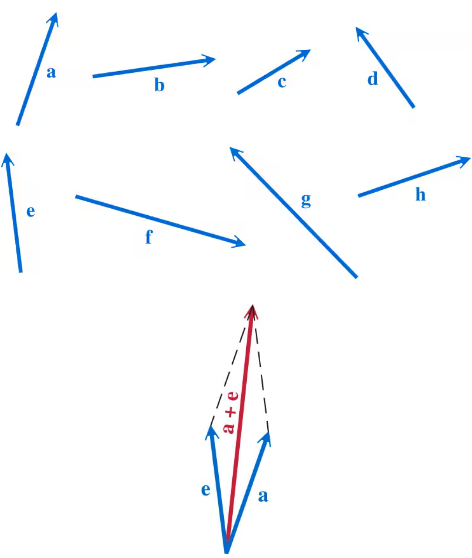
CONCEPT PREVIEW Refer to vectors a through h below. Make a copy or a sketch of each vector, and then draw a sketch to represent each of the following. For example, find a + e by placing a and e so that their initial points coincide. Then use the parallelogram rule to find the resultant, as shown in the figure on the right.
-b