
Ch 18: Thermal Properties of Matter
Young & Freedman Calc - University Physics 15th Edition
Young & Freedman Calc15th EditionUniversity PhysicsISBN: 9780135159552Not the one you use?Change textbook
Chapter 18, Problem 26a

A flask contains a mixture of neon (Ne), krypton (Kr), and radon (Rn) gases. Compare the average kinetic energies of the three types of atoms.

Verified step by step guidance
1
Understand that the average kinetic energy of a gas particle is related to its temperature, not its mass. According to the kinetic theory of gases, the average kinetic energy of a gas particle is given by the formula: 3kT2, where k is the Boltzmann constant and T is the temperature in Kelvin.
Recognize that since the gases are in the same flask, they are at the same temperature. Therefore, the average kinetic energy of neon (Ne), krypton (Kr), and radon (Rn) atoms is the same, as it depends solely on the temperature.
Consider the implications of the kinetic theory: despite differences in atomic mass, the average kinetic energy is equal for all gases at a given temperature. This is because kinetic energy is a function of temperature, not mass.
Reflect on the concept that while the average kinetic energy is the same, the speed of the atoms will differ due to their masses. Lighter atoms like neon will move faster than heavier atoms like radon at the same temperature.
Conclude that the comparison of average kinetic energies for Ne, Kr, and Rn in the flask is straightforward: they are equal, as they depend only on the temperature of the system.

Verified video answer for a similar problem:

This video solution was recommended by our tutors as helpful for the problem above.
Video duration:
1m
Was this helpful?

Key Concepts

Here are the essential concepts you must grasp in order to answer the question correctly.

Kinetic Theory of Gases

The kinetic theory of gases states that gas particles are in constant random motion and that their kinetic energy is directly proportional to the temperature of the gas. This means that at a given temperature, all gases have the same average kinetic energy, regardless of their mass or type.
Recommended video:
Guided course
01:50
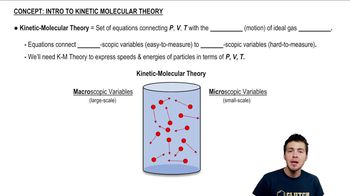
Introduction to Kinetic-Molecular Theory

Temperature and Kinetic Energy

Temperature is a measure of the average kinetic energy of the particles in a substance. In a mixture of gases at thermal equilibrium, such as neon, krypton, and radon in a flask, the average kinetic energy of the atoms is the same for all types of gases, as it depends solely on the temperature.
Recommended video:
Guided course
06:07
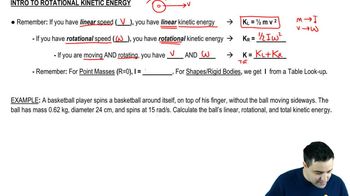
Intro to Rotational Kinetic Energy

Mass and Velocity in Gas Particles

While the average kinetic energy of gas particles is the same at a given temperature, their velocities differ due to their masses. Lighter gas particles, like neon, move faster than heavier ones, like krypton and radon, because kinetic energy is distributed as 1/2 mv^2, where m is mass and v is velocity.
Recommended video:
Guided course
07:21
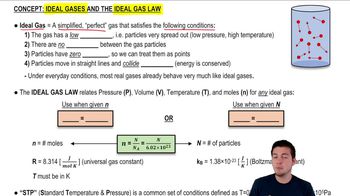
Ideal Gases and the Ideal Gas Law
Related Practice
Textbook Question

A flask contains a mixture of neon (Ne), krypton (Kr), and radon (Rn) gases. Compare the root-mean-square speeds. (Hint: Appendix D shows the molar mass (in g/mol) of each element under the chemical symbol for that element.)

20
views
Textbook Question

Oxygen (O2) has a molar mass of 32.0 32.0 g/mol. What is the average translational kinetic energy of an oxygen molecule at a temperature of 300300 K?

Textbook Question

What is the total translational kinetic energy of the air in an empty room that has dimensions 8.008.00 m×12.00\(\times\)12.00 m×4.00\(\times\)4.00 m if the air is treated as an ideal gas at 1.001.00 atm?

2
views
1
rank
Textbook Question

Consider an ideal gas at 2727°C and 1.001.00 atm. To get some idea how close these molecules are to each other, on the average, imagine them to be uniformly spaced, with each molecule at the center of a small cube. What is the length of an edge of each cube if adjacent cubes touch but do not overlap?

1
views
Textbook Question

Modern vacuum pumps make it easy to attain pressures of the order of 101310^{-13} atm in the laboratory. Consider a volume of air and treat the air as an ideal gas. How many molecules would be present at the same temperature but at 1.001.00 atm instead?

2
views
Textbook Question

The atmosphere of Mars is mostly CO2 (molar mass 44.044.0 g/mol) under a pressure of 650650 Pa, which we shall assume remains constant. In many places the temperature varies from 0.00.0°C in summer to 100-100°C in winter. Over the course of a Martian year, what are the ranges of the rms speeds of the CO2 molecules.

1
views