
A flask contains a mixture of neon (Ne), krypton (Kr), and radon (Rn) gases. Compare the root-mean-square speeds. (Hint: Appendix D shows the molar mass (in g/mol) of each element under the chemical symbol for that element.)
Oxygen (O2) has a molar mass of g/mol. What is the average translational kinetic energy of an oxygen molecule at a temperature of K?
Verified step by step guidance
Verified video answer for a similar problem:
Key Concepts
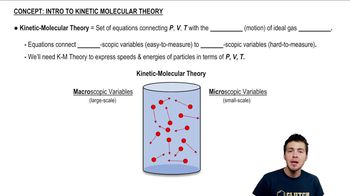
Kinetic Theory of Gases
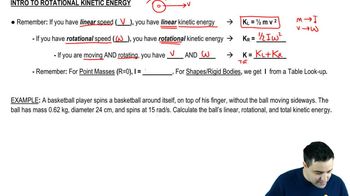
Translational Kinetic Energy
Boltzmann Constant
A flask contains a mixture of neon (Ne), krypton (Kr), and radon (Rn) gases. Compare the average kinetic energies of the three types of atoms.
Oxygen (O2) has a molar mass of g/mol. Suppose an oxygen molecule traveling at this speed bounces back and forth between opposite sides of a cubical vessel m on a side. What is the average force the molecule exerts on one of the walls of the container? (Assume that the molecule's velocity is perpendicular to the two sides that it strikes.)
Oxygen (O2) has a molar mass of g/mol. How many oxygen molecules traveling at this speed are necessary to produce an average pressure of atm?
Oxygen (O2) has a molar mass of g/mol. What is the momentum of an oxygen molecule traveling at this speed?
The atmosphere of Mars is mostly CO2 (molar mass g/mol) under a pressure of Pa, which we shall assume remains constant. In many places the temperature varies from °C in summer to °C in winter. Over the course of a Martian year, what are the ranges of the rms speeds of the CO2 molecules.
