Ch 18: Thermal Properties of Matter
Young & Freedman Calc - University Physics 15th Edition
Young & Freedman Calc15th EditionUniversity PhysicsISBN: 9780135159552Not the one you use?Change textbook
Chapter 18, Problem 31e

Oxygen (O2) has a molar mass of 32.0 32.0 g/mol. Suppose an oxygen molecule traveling at this speed bounces back and forth between opposite sides of a cubical vessel 0.100.10 m on a side. What is the average force the molecule exerts on one of the walls of the container? (Assume that the molecule's velocity is perpendicular to the two sides that it strikes.)

Verified step by step guidance
1
First, determine the speed of the oxygen molecule using the root-mean-square speed formula for gases: \( v_{rms} = \sqrt{\frac{3kT}{m}} \), where \( k \) is the Boltzmann constant, \( T \) is the temperature, and \( m \) is the mass of one molecule.
Calculate the time between collisions with the wall. Since the molecule travels back and forth across the cubical vessel, the time \( t \) between collisions is \( t = \frac{2L}{v} \), where \( L \) is the length of the side of the cube (0.10 m) and \( v \) is the speed of the molecule.
Determine the change in momentum \( \Delta p \) for each collision. The momentum change is \( \Delta p = 2mv \), where \( m \) is the mass of the molecule and \( v \) is its velocity. The factor of 2 accounts for the reversal of direction upon collision.
Calculate the average force \( F \) exerted on the wall using the impulse-momentum theorem: \( F = \frac{\Delta p}{\Delta t} \), where \( \Delta t \) is the time between collisions.
Substitute the values obtained from previous steps into the formula for average force to find the force exerted by the molecule on the wall.

Verified video answer for a similar problem:

This video solution was recommended by our tutors as helpful for the problem above.
Video duration:
13m
Was this helpful?

Key Concepts

Here are the essential concepts you must grasp in order to answer the question correctly.

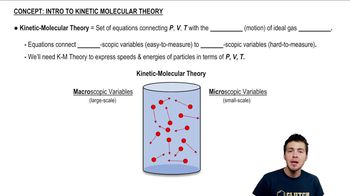
Kinetic Theory of Gases

The kinetic theory of gases explains the behavior of gas molecules in terms of their motion and interactions. It assumes that gas molecules are in constant, random motion and that they collide elastically with the walls of their container. This theory helps in understanding how the speed and mass of molecules relate to the pressure exerted on the container walls.
Recommended video:
Guided course
01:50
Introduction to Kinetic-Molecular Theory

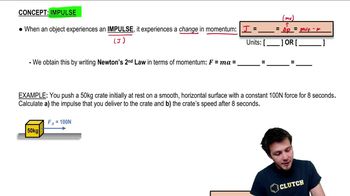
Momentum and Impulse

Momentum is the product of an object's mass and velocity, representing the quantity of motion it possesses. Impulse is the change in momentum resulting from a force applied over a time interval. In this context, the force exerted by the molecule on the container wall can be calculated by considering the change in momentum as the molecule bounces off the wall.
Recommended video:
Guided course
06:00
Impulse & Impulse-Momentum Theorem

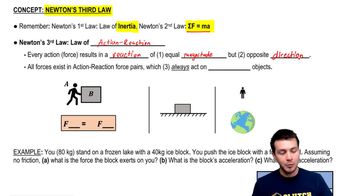
Newton's Third Law of Motion

Newton's Third Law states that for every action, there is an equal and opposite reaction. When the oxygen molecule strikes the wall of the container, it exerts a force on the wall, and the wall exerts an equal and opposite force on the molecule. This principle is crucial for calculating the average force exerted by the molecule on the container wall.
Recommended video:
Guided course
08:01
Newton's Third Law & Action-Reaction Pairs
Related Practice
Textbook Question

Oxygen (O2) has a molar mass of 32.0 32.0 g/mol. What is the average translational kinetic energy of an oxygen molecule at a temperature of 300300 K?

Textbook Question

Oxygen (O2) has a molar mass of 32.032.0 g/mol. How many oxygen molecules traveling at this speed are necessary to produce an average pressure of 11 atm?

1
views
Textbook Question

Oxygen (O2) has a molar mass of 32.0 32.0 g/mol. What is the momentum of an oxygen molecule traveling at this speed?

2
views
Textbook Question

Calculate the mean free path of air molecules at 3.50×10133.50\(\times\)10^{-13} atm and 300300 K. (This pressure is readily attainable in the laboratory; see Exercise 18.2318.23.) As in Example 18.818.8, model the air molecules as spheres of radius 2.0×10102.0\(\times\)10^{-10} m.

1
views
Textbook Question

The atmosphere of Mars is mostly CO2 (molar mass 44.044.0 g/mol) under a pressure of 650650 Pa, which we shall assume remains constant. In many places the temperature varies from 0.00.0°C in summer to 100-100°C in winter. Over the course of a Martian year, what are the ranges of the rms speeds of the CO2 molecules.

1
views
Textbook Question

At what temperature is the root-mean-square speed of nitrogen molecules equal to the root-mean-square speed of hydrogen molecules at 20.020.0°C? (Hint: Appendix D shows the molar mass (in g/mol) of each element under the chemical symbol for that element. The molar mass of H2 is twice the molar mass of hydrogen atoms, and similarly for N2.)

2
views