
Ch 18: Thermal Properties of Matter
Young & Freedman Calc - University Physics 15th Edition
Young & Freedman Calc15th EditionUniversity PhysicsISBN: 9780135159552Not the one you use?Change textbook
Chapter 18, Problem 30a

The atmosphere of Mars is mostly CO2 (molar mass 44.044.0 g/mol) under a pressure of 650650 Pa, which we shall assume remains constant. In many places the temperature varies from 0.00.0°C in summer to 100-100°C in winter. Over the course of a Martian year, what are the ranges of the rms speeds of the CO2 molecules.

Verified step by step guidance
1
First, convert the given temperatures from Celsius to Kelvin. The formula for conversion is: \( T(K) = T(°C) + 273.15 \). So, for summer, \( T_{summer} = 0.0°C + 273.15 = 273.15 \text{ K} \) and for winter, \( T_{winter} = -100°C + 273.15 = 173.15 \text{ K} \).
Next, use the formula for the root mean square (rms) speed of gas molecules: \( v_{rms} = \sqrt{\frac{3kT}{m}} \), where \( k \) is the Boltzmann constant \( (1.38 \times 10^{-23} \text{ J/K}) \), \( T \) is the temperature in Kelvin, and \( m \) is the mass of a single molecule in kilograms.
Calculate the mass of a single CO2 molecule. The molar mass of CO2 is 44.0 g/mol, which is \( 44.0 \times 10^{-3} \text{ kg/mol} \). To find the mass of one molecule, divide by Avogadro's number \( (6.022 \times 10^{23} \text{ molecules/mol}) \): \( m = \frac{44.0 \times 10^{-3}}{6.022 \times 10^{23}} \text{ kg} \).
Substitute the values for summer into the rms speed formula: \( v_{rms, summer} = \sqrt{\frac{3 \times 1.38 \times 10^{-23} \times 273.15}{m}} \).
Substitute the values for winter into the rms speed formula: \( v_{rms, winter} = \sqrt{\frac{3 \times 1.38 \times 10^{-23} \times 173.15}{m}} \). This will give you the range of rms speeds over the course of a Martian year.

Verified video answer for a similar problem:

This video solution was recommended by our tutors as helpful for the problem above.
Video duration:
3m
Was this helpful?

Key Concepts

Here are the essential concepts you must grasp in order to answer the question correctly.

Root Mean Square Speed

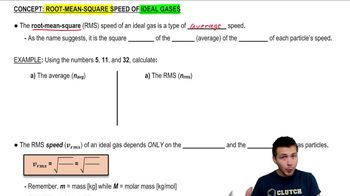
The root mean square (rms) speed is a measure of the average speed of particles in a gas, derived from the kinetic theory of gases. It is calculated using the formula v_rms = sqrt((3kT)/m), where k is the Boltzmann constant, T is the temperature in Kelvin, and m is the molar mass of the gas. This concept helps in understanding how temperature affects the speed of gas molecules.
Recommended video:
Guided course
05:21
Root-Mean-Square Speed of Ideal Gases

Temperature Conversion

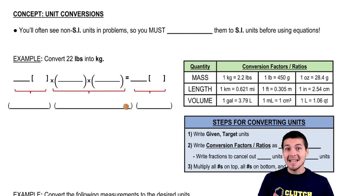
Temperature conversion is essential for calculations involving gas laws, as these typically require temperatures in Kelvin. To convert Celsius to Kelvin, add 273.15 to the Celsius temperature. For Mars, the temperatures of 0.0°C and -100°C convert to 273.15 K and 173.15 K, respectively, which are necessary for calculating the rms speeds of CO2 molecules.
Recommended video:
Guided course
07:46
Unit Conversions

Ideal Gas Law

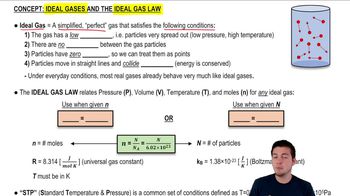
The ideal gas law, PV = nRT, relates the pressure, volume, and temperature of a gas with its amount in moles. Although the pressure is constant in this scenario, understanding this law helps in comprehending how temperature variations affect gas properties. It provides a framework for analyzing the behavior of gases under different conditions, such as those on Mars.
Recommended video:
Guided course
07:21
Ideal Gases and the Ideal Gas Law