Ch 18: Thermal Properties of Matter
Young & Freedman Calc - University Physics 15th Edition
Young & Freedman Calc15th EditionUniversity PhysicsISBN: 9780135159552Not the one you use?Change textbook
Chapter 18, Problem 26b

A flask contains a mixture of neon (Ne), krypton (Kr), and radon (Rn) gases. Compare the root-mean-square speeds. (Hint: Appendix D shows the molar mass (in g/mol) of each element under the chemical symbol for that element.)

Verified step by step guidance
1
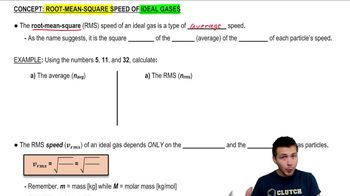
First, understand the concept of root-mean-square speed (v_rms) for gases. It is a measure of the average speed of particles in a gas and is given by the formula: 3kTm, where k is the Boltzmann constant, T is the temperature in Kelvin, and m is the mass of a single molecule.
Next, convert the molar mass of each gas (Ne, Kr, Rn) from grams per mole to kilograms per molecule. Use the molar mass values from Appendix D: Neon (Ne) is approximately 20.18 g/mol, Krypton (Kr) is approximately 83.80 g/mol, and Radon (Rn) is approximately 222 g/mol. Convert these to kilograms by dividing by 1000, and then divide by Avogadro's number (6.022×10·23 molecules/mol) to get the mass of a single molecule.
Substitute the mass of each molecule into the root-mean-square speed formula. Since the temperature T and Boltzmann constant k are constants, the root-mean-square speed is inversely proportional to the square root of the mass of the molecule.
Compare the root-mean-square speeds for each gas. Since the mass of Neon is the smallest, it will have the highest root-mean-square speed. Krypton, with a larger mass, will have a lower speed than Neon, and Radon, with the largest mass, will have the lowest speed.
Conclude that the root-mean-square speed decreases as the molar mass increases. Therefore, the order of root-mean-square speeds from highest to lowest is Neon, Krypton, and Radon.

Verified video answer for a similar problem:

This video solution was recommended by our tutors as helpful for the problem above.
Video duration:
2m
Was this helpful?

Key Concepts

Here are the essential concepts you must grasp in order to answer the question correctly.

Root-Mean-Square Speed

The root-mean-square speed is a measure of the average speed of particles in a gas, derived from the kinetic theory of gases. It is calculated using the formula v_rms = sqrt(3kT/m), where k is the Boltzmann constant, T is the temperature in Kelvin, and m is the mass of a gas particle. This concept helps compare the speeds of different gas molecules at a given temperature.
Recommended video:
Guided course
05:21
Root-Mean-Square Speed of Ideal Gases

Molar Mass

Molar mass is the mass of one mole of a substance, typically expressed in grams per mole (g/mol). It is crucial for determining the mass of individual gas particles, which affects their root-mean-square speed. In this context, knowing the molar mass of neon, krypton, and radon allows us to compare their speeds, as lighter gases tend to move faster than heavier ones.
Recommended video:
Guided course
20:32
Mass Spectrometers

Kinetic Theory of Gases

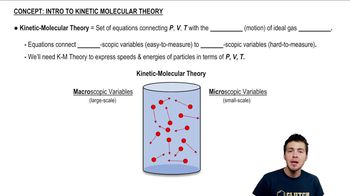
The kinetic theory of gases explains the behavior of gases in terms of the motion of their particles. It assumes that gas particles are in constant, random motion and that their collisions are perfectly elastic. This theory provides the foundation for understanding concepts like pressure, temperature, and root-mean-square speed, as it relates the macroscopic properties of gases to the microscopic motion of their molecules.
Recommended video:
Guided course
01:50
Introduction to Kinetic-Molecular Theory