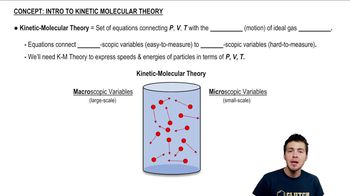
A flask contains a mixture of neon (Ne), krypton (Kr), and radon (Rn) gases. Compare the root-mean-square speeds. (Hint: Appendix D shows the molar mass (in g/mol) of each element under the chemical symbol for that element.)
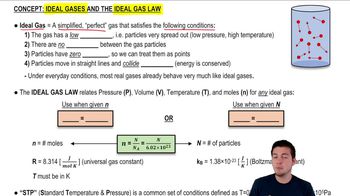
Consider an ideal gas at °C and atm. To get some idea how close these molecules are to each other, on the average, imagine them to be uniformly spaced, with each molecule at the center of a small cube. What is the length of an edge of each cube if adjacent cubes touch but do not overlap?
Verified step by step guidance
Verified video answer for a similar problem:
Key Concepts
Ideal Gas Law
Molecular Volume
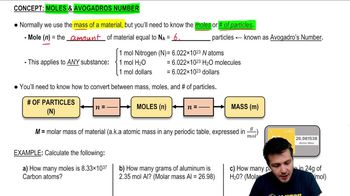
Avogadro's Number
A flask contains a mixture of neon (Ne), krypton (Kr), and radon (Rn) gases. Compare the average kinetic energies of the three types of atoms.
Modern vacuum pumps make it easy to attain pressures of the order of atm in the laboratory. Consider a volume of air and treat the air as an ideal gas. At a pressure of atm and an ordinary temperature of K, how many molecules are present in a volume of cm3?
What is the total translational kinetic energy of the air in an empty room that has dimensions m m m if the air is treated as an ideal gas at atm?
A large organic molecule has a mass of kg. What is the molar mass of this compound?
Modern vacuum pumps make it easy to attain pressures of the order of atm in the laboratory. Consider a volume of air and treat the air as an ideal gas. How many molecules would be present at the same temperature but at atm instead?
