Ch 18: Thermal Properties of Matter
Young & Freedman Calc - University Physics 15th Edition
Young & Freedman Calc15th EditionUniversity PhysicsISBN: 9780135159552Not the one you use?Change textbook
Chapter 18, Problem 21b

Modern vacuum pumps make it easy to attain pressures of the order of 101310^{-13} atm in the laboratory. Consider a volume of air and treat the air as an ideal gas. How many molecules would be present at the same temperature but at 1.001.00 atm instead?

Verified step by step guidance
1
Start by recalling the ideal gas law, which is given by the equation: PV=nRT, where P is the pressure, V is the volume, n is the number of moles, R is the ideal gas constant, and T is the temperature.
To find the number of molecules, we need to determine the number of moles first. Rearrange the ideal gas law to solve for n: n=PVRT.
Assume the volume V and temperature T remain constant. Substitute P with 1.00 atm, and use the ideal gas constant R in appropriate units (e.g., 0.0821 L atm/mol K).
Calculate the number of moles n using the rearranged equation. This will give you the moles of gas at 1.00 atm.
Finally, convert the number of moles to molecules using Avogadro's number, which is approximately 6.022×10²³ molecules/mol. Multiply the moles by Avogadro's number to find the total number of molecules.

Verified video answer for a similar problem:

This video solution was recommended by our tutors as helpful for the problem above.
Video duration:
4m
Was this helpful?

Key Concepts

Here are the essential concepts you must grasp in order to answer the question correctly.

Ideal Gas Law

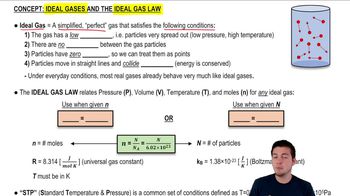
The Ideal Gas Law is a fundamental equation in physics that relates the pressure, volume, and temperature of an ideal gas with the number of molecules. It is expressed as PV = nRT, where P is pressure, V is volume, n is the number of moles, R is the gas constant, and T is temperature. This law helps in calculating the number of molecules when conditions such as pressure change.
Recommended video:
Guided course
07:21
Ideal Gases and the Ideal Gas Law

Mole Concept

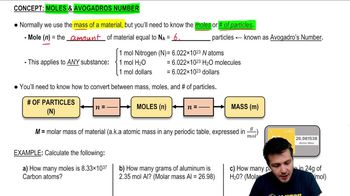
The mole concept is essential for quantifying the amount of substance in chemistry and physics. One mole corresponds to Avogadro's number, approximately 6.022 x 10^23 molecules. Understanding this concept allows us to convert between the number of molecules and moles, which is crucial when using the Ideal Gas Law to find the number of molecules at different pressures.
Recommended video:
Guided course
07:19
Moles & Avogadro's Number

Pressure

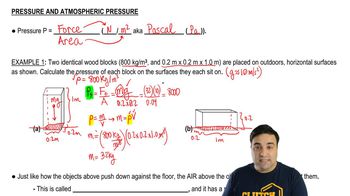
Pressure is the force exerted by gas molecules per unit area on the walls of a container. It is measured in units such as atmospheres (atm). In the context of the question, understanding how pressure changes affect the number of molecules in a given volume is key, as the pressure is directly proportional to the number of molecules in the Ideal Gas Law.
Recommended video:
Guided course
17:04
Pressure and Atmospheric Pressure