
Textbook Question
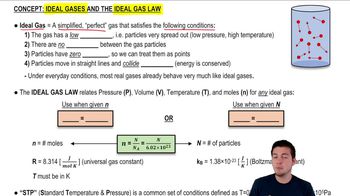
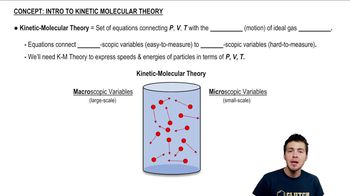
What is the total translational kinetic energy of the air in an empty room that has dimensions m m m if the air is treated as an ideal gas at atm?
2
views
1
rank
 Verified step by step guidance
 07:21
07:21
 01:50
01:50 07:46
07:46What is the total translational kinetic energy of the air in an empty room that has dimensions m m m if the air is treated as an ideal gas at atm?
Martian Climate. The atmosphere of Mars is mostly CO2 (molar mass 44.0 g/mol) under a pressure of 650 Pa, which we shall assume remains constant. In many places the temperature varies from 0.0°C in summer to -100°C in winter. Over the course of a Martian year, what are the ranges of (b) the density (in mol/m^3) of the atmosphere?
A large organic molecule has a mass of kg. What is the molar mass of this compound?
How many moles are in a -kg bottle of water? How many molecules? The molar mass of water is g/mol.
Consider an ideal gas at °C and atm. To get some idea how close these molecules are to each other, on the average, imagine them to be uniformly spaced, with each molecule at the center of a small cube. What is the length of an edge of each cube if adjacent cubes touch but do not overlap?
Modern vacuum pumps make it easy to attain pressures of the order of atm in the laboratory. Consider a volume of air and treat the air as an ideal gas. How many molecules would be present at the same temperature but at atm instead?