Ch 21: Heat Engines and Refrigerators
Knight Calc - Physics for Scientists and Engineers 5th Edition
Knight Calc5th EditionPhysics for Scientists and EngineersISBN: 9780137344796Not the one you use?Change textbook
Chapter 21, Problem 19b

An air conditioner removes 5.0 x 10⁵ J/min of heat from a house and exhausts 8.0 x 10⁵ J/min to the hot outdoors. What is the air conditioner's coefficient of performance?

Verified step by step guidance
1
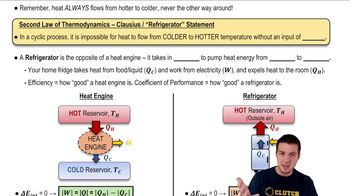
The coefficient of performance (COP) for a cooling device is defined as the ratio of the heat removed from the cold reservoir (house) to the work input required to operate the device. Mathematically, it is expressed as: COP=QcW, where Qc is the heat removed from the cold reservoir and W is the work input.
The work input W can be determined using the first law of thermodynamics, which states that the total energy input to the system is equal to the sum of the heat removed from the cold reservoir and the heat exhausted to the hot reservoir. Mathematically: W=Qh-Qc, where Qh is the heat exhausted to the hot reservoir.
Substitute the given values into the equation for work: W=(8.0×10⁵)-(5.0×10⁵). This will give the value of W in joules per minute.
Now, substitute the values of Qc and W into the COP formula: COP=(5.0×10⁵)(Qc).
Simplify the expression to calculate the coefficient of performance (COP). This will give you the final value of the air conditioner's COP.

Verified video answer for a similar problem:

This video solution was recommended by our tutors as helpful for the problem above.
Video duration:
3m
Was this helpful?

Key Concepts

Here are the essential concepts you must grasp in order to answer the question correctly.

Coefficient of Performance (COP)

The Coefficient of Performance (COP) is a measure of the efficiency of a heat pump or air conditioning system. It is defined as the ratio of the heat removed from the cooled space (useful output) to the work input (energy consumed) required to remove that heat. A higher COP indicates a more efficient system, as it means more heat is removed per unit of energy consumed.
Recommended video:
Guided course
06:47
Refrigerators

Heat Transfer

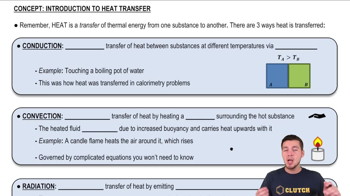
Heat transfer refers to the movement of thermal energy from one physical system to another. In the context of air conditioning, it involves the removal of heat from the indoor environment and its release to the outdoor environment. Understanding the principles of heat transfer, including conduction, convection, and radiation, is essential for analyzing the performance of HVAC systems.
Recommended video:
Guided course
05:14
Overview of Heat Transfer

Energy Units and Conversion

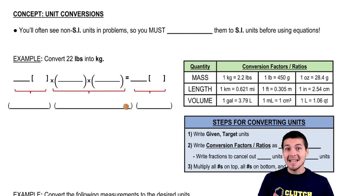
In physics, energy is often measured in joules (J), and understanding how to convert between different units of energy and power is crucial for solving problems related to energy consumption. In this case, the air conditioner’s heat removal and exhaust rates are given in joules per minute, which may need to be converted to a consistent unit when calculating the COP. Familiarity with these conversions ensures accurate calculations and comparisons.
Recommended video:
Guided course
07:46
Unit Conversions