Ch 21: Heat Engines and Refrigerators
Knight Calc - Physics for Scientists and Engineers 5th Edition
Knight Calc5th EditionPhysics for Scientists and EngineersISBN: 9780137344796Not the one you use?Change textbook
Chapter 21, Problem 14

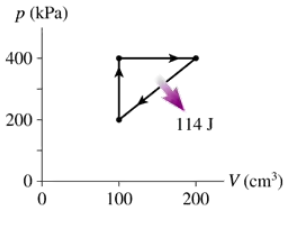
What are (a) Wout and QH and (b) the thermal efficiency for the heat engine shown in FIGURE EX21.14?

Verified step by step guidance
1
Step 1: Understand the problem. The heat engine operates between two reservoirs, absorbing heat (QH) from the hot reservoir and performing work (Wₒᵤₜ) while expelling heat (QC) to the cold reservoir. The thermal efficiency (η) is defined as the ratio of work output to heat input: η = Wₒᵤₜ / QH.
Step 2: Identify the given values from FIGURE EX21.14. Extract the values for QH (heat absorbed from the hot reservoir) and QC (heat expelled to the cold reservoir). These values are typically provided in the figure or accompanying text.
Step 3: Calculate the work output (Wₒᵤₜ) using the first law of thermodynamics for a heat engine: Wₒᵤₜ = QH - QC. Subtract the heat expelled (QC) from the heat absorbed (QH).
Step 4: Determine the thermal efficiency (η) using the formula η = Wₒᵤₜ / QH. Divide the work output (Wₒᵤₜ) by the heat input (QH) to find the efficiency of the engine.
Step 5: Express the thermal efficiency as a percentage by multiplying the result by 100: η (%) = (Wₒᵤₜ / QH) × 100. This gives the efficiency in a more interpretable form.

Verified video answer for a similar problem:

This video solution was recommended by our tutors as helpful for the problem above.
Was this helpful?

Key Concepts

Here are the essential concepts you must grasp in order to answer the question correctly.

Work Output (Wₒᵤₜ)

Work output (Wₒᵤₜ) refers to the useful work produced by a heat engine during its operation. It is calculated as the difference between the energy input from the heat source and the energy rejected to the heat sink. This concept is crucial for evaluating the performance of the engine, as it directly relates to the engine's ability to convert thermal energy into mechanical energy.
Recommended video:
Guided course
06:58
Power Output of a Gasoline Engine

Heat Input (QH)

Heat input (QH) is the total amount of thermal energy absorbed by the heat engine from the heat source during one complete cycle. This energy is essential for the engine's operation, as it provides the necessary energy to perform work. Understanding QH is vital for calculating the thermal efficiency of the engine, as it serves as the baseline for comparing the work output.
Recommended video:
Guided course
07:35
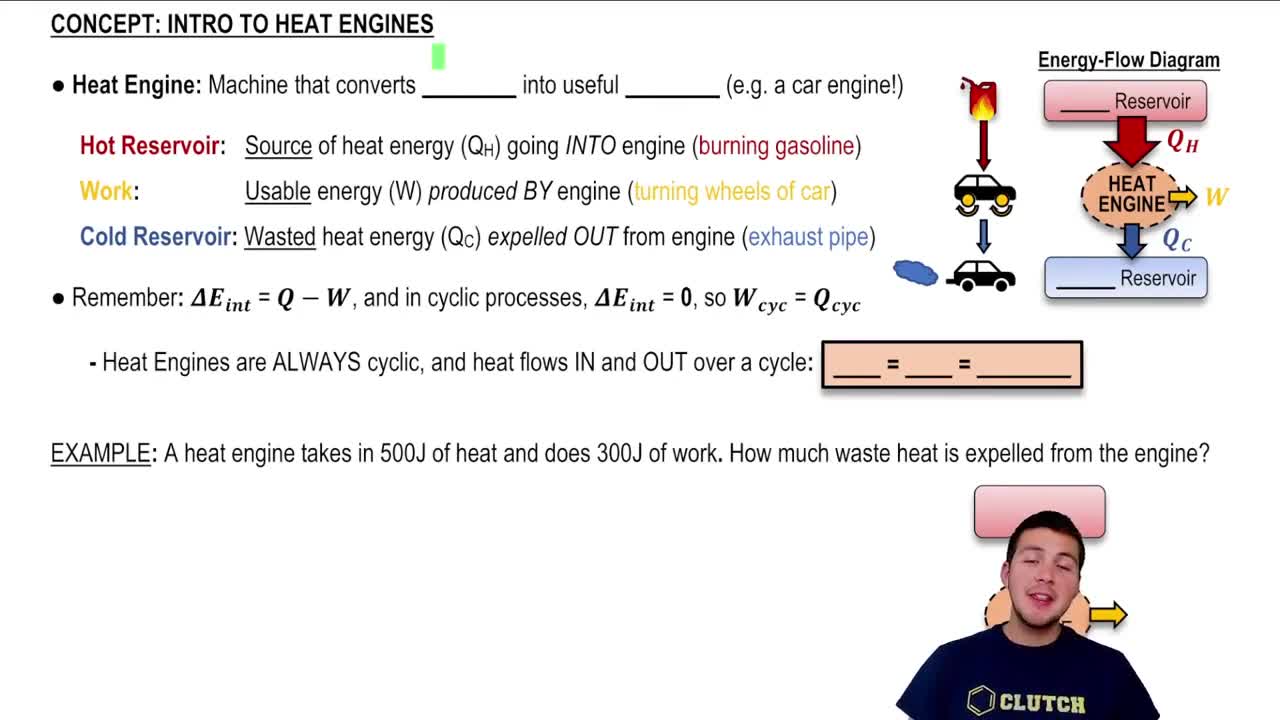
Introduction to Heat Engines

Thermal Efficiency

Thermal efficiency is a measure of how effectively a heat engine converts heat energy into work. It is defined as the ratio of the work output (Wₒᵤₜ) to the heat input (QH), often expressed as a percentage. A higher thermal efficiency indicates a more effective engine, and it is a key performance indicator in thermodynamics, helping to assess the effectiveness of different engine designs.
Recommended video:
Guided course
06:01
Thermal Efficiency & The Second Law of Thermodynamics