Ch 21: Heat Engines and Refrigerators
Knight Calc - Physics for Scientists and Engineers 5th Edition
Knight Calc5th EditionPhysics for Scientists and EngineersISBN: 9780137344796Not the one you use?Change textbook
Chapter 21, Problem 18

A 15 kW electric generator burns 1.2 gal of diesel fuel per hour. The energy density of diesel fuel is 140 MJ/gal. What is the generator's thermal efficiency?

Verified step by step guidance
1
Step 1: Understand the concept of thermal efficiency. Thermal efficiency is the ratio of useful output energy (or power) to the input energy supplied to the system. It is expressed as a percentage and calculated using the formula: η=PQ×100, where P is the output power and Q is the input energy per unit time.
Step 2: Calculate the input energy per hour. The energy density of diesel fuel is given as 140 MJ/gal, and the generator burns 1.2 gal of diesel fuel per hour. Multiply the energy density by the fuel consumption rate to find the input energy per hour: Q=140×1.2 MJ/hour.
Step 3: Convert the output power from kilowatts to megajoules per hour. Since 1 kW is equal to 1 kJ/s, and there are 3600 seconds in an hour, multiply the generator's output power (15 kW) by 3600 to convert it to MJ/hour: P=15×3600 kJ/hour.
Step 4: Substitute the values of P and Q into the thermal efficiency formula. Use the formula η=PQ×100 to calculate the efficiency.
Step 5: Simplify the expression to find the thermal efficiency as a percentage. Ensure the units are consistent throughout the calculation (MJ/hour for both P and Q).

Verified video answer for a similar problem:

This video solution was recommended by our tutors as helpful for the problem above.
Video duration:
4m
Was this helpful?

Key Concepts

Here are the essential concepts you must grasp in order to answer the question correctly.

Thermal Efficiency

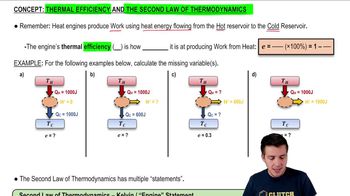
Thermal efficiency is a measure of how well an energy conversion process converts input energy into useful output energy. It is defined as the ratio of the useful work output to the total energy input, often expressed as a percentage. In this context, it helps determine how effectively the generator converts the energy from diesel fuel into electrical energy.
Recommended video:
Guided course
06:01
Thermal Efficiency & The Second Law of Thermodynamics

Energy Density

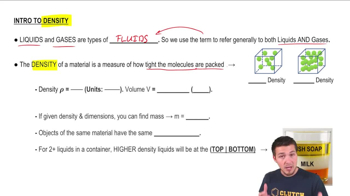
Energy density refers to the amount of energy stored in a given volume or mass of a substance, typically expressed in units like MJ/gal or J/kg. For diesel fuel, an energy density of 140 MJ/gal indicates how much energy can be extracted from one gallon of fuel. This concept is crucial for calculating the total energy input to the generator from the fuel consumed.
Recommended video:
Guided course
8:13
Intro to Density

Power Output

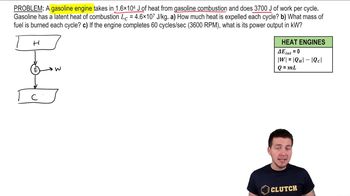
Power output is the rate at which energy is produced or consumed, measured in watts (W) or kilowatts (kW). In this scenario, the generator has a power output of 15 kW, meaning it generates 15 kilojoules of electrical energy per second. Understanding power output is essential for comparing it to the energy input from the fuel to determine the thermal efficiency.
Recommended video:
Guided course
06:58
Power Output of a Gasoline Engine