Ch 21: Heat Engines and Refrigerators
Knight Calc - Physics for Scientists and Engineers 5th Edition
Knight Calc5th EditionPhysics for Scientists and EngineersISBN: 9780137344796Not the one you use?Change textbook
Chapter 21, Problem 21a

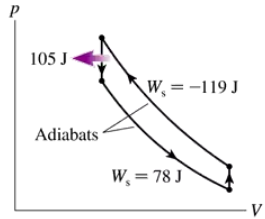
What are (a) the heat extracted from the cold reservoir and (b) the coefficient of performance for the refrigerator shown in FIGURE EX21.21?

Verified step by step guidance
1
Identify the key variables and concepts involved in the problem. For a refrigerator, the coefficient of performance (COP) is defined as \( \text{COP} = \frac{Q_c}{W} \), where \( Q_c \) is the heat extracted from the cold reservoir and \( W \) is the work done on the system. The first law of thermodynamics also applies: \( W = Q_h - Q_c \), where \( Q_h \) is the heat released to the hot reservoir.
From the problem or figure, determine the values of \( Q_h \) (heat released to the hot reservoir) and \( W \) (work done on the system). If these values are not directly given, use any provided data to calculate them.
Rearrange the first law of thermodynamics equation \( W = Q_h - Q_c \) to solve for \( Q_c \): \( Q_c = Q_h - W \). Substitute the known values of \( Q_h \) and \( W \) to calculate \( Q_c \), the heat extracted from the cold reservoir.
Use the definition of the coefficient of performance (COP): \( \text{COP} = \frac{Q_c}{W} \). Substitute the calculated value of \( Q_c \) and the given or calculated value of \( W \) to find the COP of the refrigerator.
Verify the units and ensure consistency throughout the calculations. The heat quantities \( Q_c \) and \( Q_h \) should be in joules (J), and the work \( W \) should also be in joules (J). The COP is a dimensionless quantity.

Verified video answer for a similar problem:

This video solution was recommended by our tutors as helpful for the problem above.
Video duration:
4m
Was this helpful?

Key Concepts

Here are the essential concepts you must grasp in order to answer the question correctly.

Heat Transfer

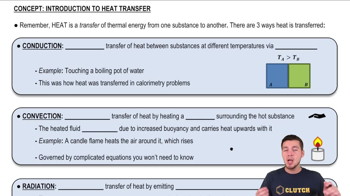
Heat transfer refers to the movement of thermal energy from one object or system to another due to a temperature difference. In the context of refrigeration, heat is extracted from the cold reservoir, which is the area being cooled, and transferred to the hot reservoir, typically the surrounding environment. Understanding the principles of heat transfer is essential for analyzing the efficiency and operation of refrigeration systems.
Recommended video:
Guided course
05:14
Overview of Heat Transfer

Refrigerator Coefficient of Performance (COP)

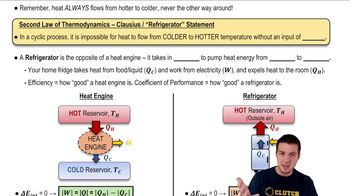
The Coefficient of Performance (COP) of a refrigerator is a measure of its efficiency, defined as the ratio of the heat removed from the cold reservoir to the work input required to remove that heat. A higher COP indicates a more efficient refrigerator, as it means more heat is extracted for each unit of work done. This concept is crucial for evaluating the performance of refrigeration systems and understanding their energy consumption.
Recommended video:
Guided course
06:47
Refrigerators

Thermodynamic Cycles

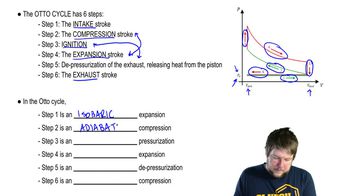
Thermodynamic cycles describe the series of processes that a refrigerant undergoes in a refrigeration system, including compression, condensation, expansion, and evaporation. These cycles are fundamental to understanding how refrigerators operate, as they illustrate how energy is transferred and transformed within the system. Familiarity with these cycles helps in analyzing the performance and efficiency of refrigeration systems.
Recommended video:
Guided course
10:59
The Otto Cycle