Ch 21: Heat Engines and Refrigerators
Knight Calc - Physics for Scientists and Engineers 5th Edition
Knight Calc5th EditionPhysics for Scientists and EngineersISBN: 9780137344796Not the one you use?Change textbook
Chapter 21, Problem 22

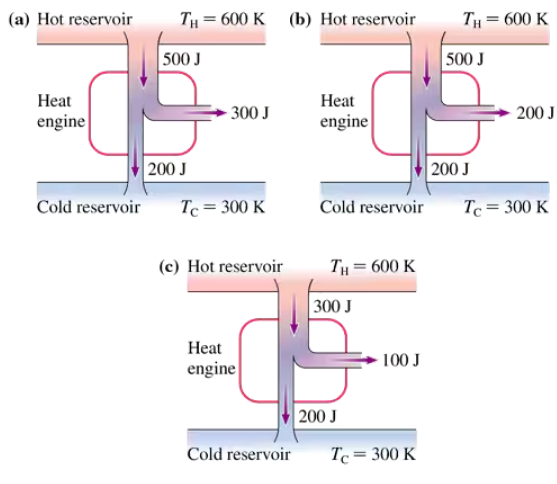
Which, if any, of the heat engines in FIGURE EX21.22 violate (a) the first law of thermodynamics or (b) the second law of thermodynamics? Explain.

Verified step by step guidance
1
Step 1: Review the first law of thermodynamics, which states that energy cannot be created or destroyed, only transferred or transformed. In the context of heat engines, this means the total energy input must equal the sum of the work output and the heat rejected.
Step 2: Examine the second law of thermodynamics, which states that no heat engine can be 100% efficient. Some energy must always be rejected as waste heat to a lower-temperature reservoir.
Step 3: Analyze the heat engines in FIGURE EX21.22. For each engine, check whether the energy input equals the sum of the work output and heat rejected. If this condition is violated, the engine violates the first law of thermodynamics.
Step 4: For each engine, calculate the efficiency using the formula: e=WQ, where W is the work output and Q is the heat input. Compare the efficiency to the theoretical maximum efficiency given by the Carnot efficiency formula: e=(Th-Tc)Th, where Th and Tc are the temperatures of the hot and cold reservoirs, respectively.
Step 5: Determine if any engine violates the second law of thermodynamics by achieving an efficiency greater than the Carnot efficiency or by failing to reject waste heat. Summarize your findings for both laws for each engine in the figure.

Verified video answer for a similar problem:

This video solution was recommended by our tutors as helpful for the problem above.
Video duration:
6m
Was this helpful?

Key Concepts

Here are the essential concepts you must grasp in order to answer the question correctly.

First Law of Thermodynamics

The First Law of Thermodynamics, also known as the law of energy conservation, states that energy cannot be created or destroyed, only transformed from one form to another. In the context of heat engines, this means that the total energy input into the system must equal the total energy output, accounting for work done and heat transferred. Any violation of this principle would imply an unaccounted energy source or loss.
Recommended video:
Guided course
08:04
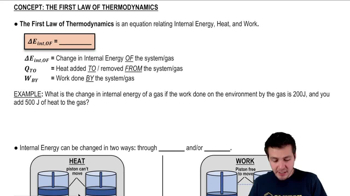
The First Law of Thermodynamics

Second Law of Thermodynamics

The Second Law of Thermodynamics states that in any energy transfer or transformation, the total entropy of a closed system can never decrease over time. This implies that heat cannot spontaneously flow from a colder body to a hotter body without external work. In terms of heat engines, this law sets a limit on the efficiency of the engine, as some energy will always be lost as waste heat.
Recommended video:
Guided course
06:01
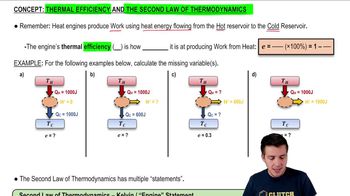
Thermal Efficiency & The Second Law of Thermodynamics

Heat Engine Efficiency

Heat engine efficiency is a measure of how well a heat engine converts heat energy into work. It is defined as the ratio of the work output to the heat input, often expressed as a percentage. The efficiency of a heat engine is constrained by the Second Law of Thermodynamics, which dictates that no engine can be 100% efficient due to inevitable energy losses, primarily as waste heat.
Recommended video:
Guided course
07:35
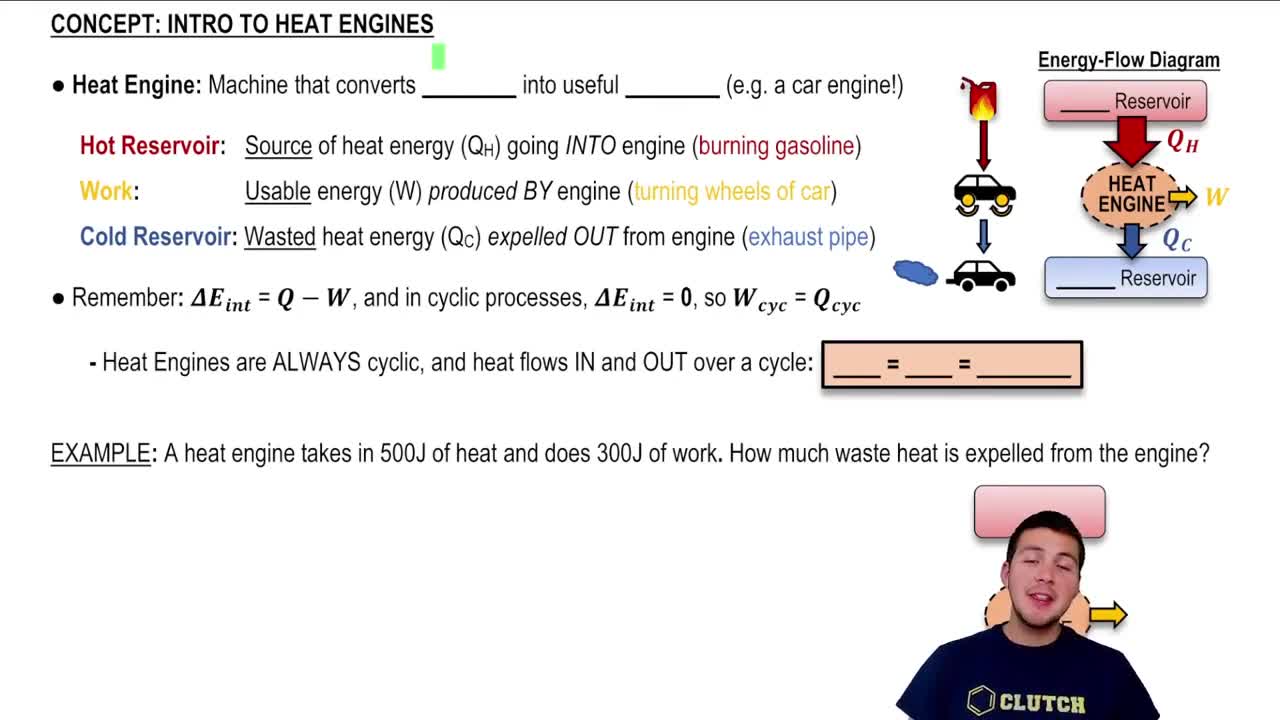
Introduction to Heat Engines