
Ch 21: Heat Engines and Refrigerators
Knight Calc - Physics for Scientists and Engineers 5th Edition
Knight Calc5th EditionPhysics for Scientists and EngineersISBN: 9780137344796Not the one you use?Change textbook
Chapter 21, Problem 38

The engine that powers a crane burns fuel at a flame temperature of 2000℃. It is cooled by 20℃ air. The crane lifts a 2000 kg steel girder 30 m upward. How much heat energy is transferred to the engine by burning fuel if the engine is 40% as efficient as a Carnot engine?

Verified step by step guidance
1
Convert the given temperatures from Celsius to Kelvin using the formula: \( T(K) = T(℃) + 273.15 \). For the flame temperature, \( T_{hot} = 2000 + 273.15 \), and for the cooling air, \( T_{cold} = 20 + 273.15 \).
Calculate the efficiency of a Carnot engine using the formula: \( \eta_{Carnot} = 1 - \frac{T_{cold}}{T_{hot}} \). Substitute the values of \( T_{cold} \) and \( T_{hot} \) in Kelvin to find \( \eta_{Carnot} \).
Determine the actual efficiency of the engine, which is 40% of the Carnot efficiency. Use the formula: \( \eta_{actual} = 0.4 \times \eta_{Carnot} \).
Calculate the work done by the crane to lift the girder using the formula: \( W = m \cdot g \cdot h \), where \( m = 2000 \ \mathrm{kg} \), \( g = 9.8 \ \mathrm{m/s^2} \), and \( h = 30 \ \mathrm{m} \).
Relate the work done to the heat energy transferred to the engine using the efficiency formula: \( \eta_{actual} = \frac{W}{Q_{in}} \). Rearrange to solve for \( Q_{in} \): \( Q_{in} = \frac{W}{\eta_{actual}} \). Substitute the values of \( W \) and \( \eta_{actual} \) to find the heat energy transferred.

Verified video answer for a similar problem:

This video solution was recommended by our tutors as helpful for the problem above.
Video duration:
7m
Was this helpful?

Key Concepts

Here are the essential concepts you must grasp in order to answer the question correctly.

Carnot Efficiency

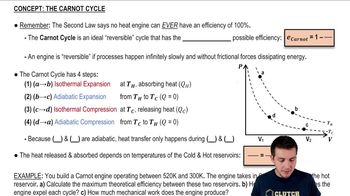
Carnot efficiency is the maximum possible efficiency of a heat engine operating between two temperature reservoirs. It is defined by the formula η = 1 - (T_c / T_h), where T_c is the absolute temperature of the cold reservoir and T_h is the absolute temperature of the hot reservoir. This concept sets an ideal benchmark for real engines, indicating that no engine can be more efficient than a Carnot engine operating between the same temperatures.
Recommended video:
Guided course
06:28
The Carnot Cycle and Maximum Theoretical Efficiency

Heat Transfer

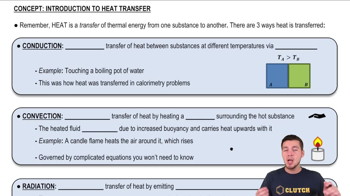
Heat transfer refers to the movement of thermal energy from one object or system to another due to a temperature difference. In the context of engines, heat is transferred from the combustion of fuel to the working fluid, which then performs work, such as lifting a load. Understanding how heat is transferred and utilized is crucial for calculating the energy output and efficiency of the engine.
Recommended video:
Guided course
05:14
Overview of Heat Transfer

Work Done by the Engine

The work done by an engine is the energy transferred to lift an object against gravity, calculated using the formula W = mgh, where m is the mass, g is the acceleration due to gravity, and h is the height lifted. In this scenario, the crane lifts a 2000 kg girder 30 m, and calculating this work is essential for determining the total energy input required from the fuel burned, factoring in the engine's efficiency.
Recommended video:
Guided course
05:58
Work Done By Springs
Related Practice