
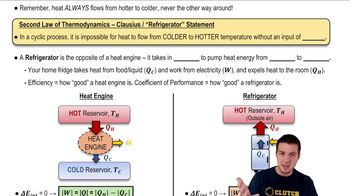
An ideal refrigerator utilizes a Carnot cycle operating between 0℃ and 25℃. To turn 10 kg of liquid water at 0℃ into 10 kg of ice at 0℃, (a) how much heat is exhausted into the room and (b) how much energy must be supplied to the refrigerator?
A freezer with a coefficient of performance 30% that of a Carnot refrigerator keeps the inside temperature at -22℃ in a 25℃ room. 3.0 L of water at 20℃ are placed in the freezer. How long does it take for the water to freeze if the freezer's compressor does work at the rate of 200 W while the water is freezing?
Verified step by step guidance
Verified video answer for a similar problem:
Key Concepts
Coefficient of Performance (COP)
Heat Transfer and Latent Heat
Power and Energy Relationship
FIGURE P21.46 shows a Carnot heat engine driving a Carnot refrigerator. Determine Q2, Q3 and Q4.
A Carnot refrigerator operates between energy reservoirs at 0℃ and 250℃. A 2.4-cm-diameter, 50-cm-long copper bar connects the two energy reservoirs. At what rate, in W, must work be done on the refrigerator to remove heat from the cold reservoir at the same rate that it arrives through the copper bar?
A Carnot heat engine operates between reservoirs at 182℃ and 0℃. If the engine extracts 25 J of energy from the hot reservoir per cycle, how many cycles will it take to lift a 10 kg mass a height of 10 m?
The engine that powers a crane burns fuel at a flame temperature of 2000℃. It is cooled by 20℃ air. The crane lifts a 2000 kg steel girder 30 m upward. How much heat energy is transferred to the engine by burning fuel if the engine is 40% as efficient as a Carnot engine?
A Carnot engine operates between temperatures of 5℃ and 500℃. The output is used to run a Carnot refrigerator operating between -5℃ and 25℃. How many joules of heat energy does the refrigerator exhaust into the room for each joule of heat energy used by the heat engine?
