
A car's internal combustion engine can be modeled as a heat engine operating between a combustion temperature of 1500℃ and an air temperature of 20℃ with 30% of the Carnot efficiency. The heat of combustion of gasoline is 47 kJ/g. What mass of gasoline is burned to accelerate a 1500 kg car from rest to a speed of 30 m/s?
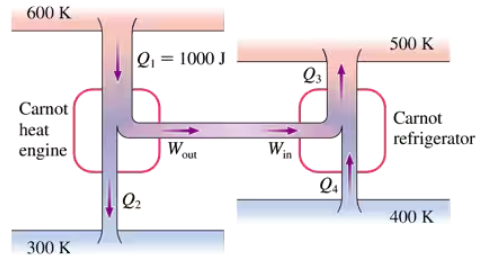
FIGURE P21.46 shows a Carnot heat engine driving a Carnot refrigerator. Determine Q2, Q3 and Q4.

Verified step by step guidance
Verified video answer for a similar problem:
Key Concepts
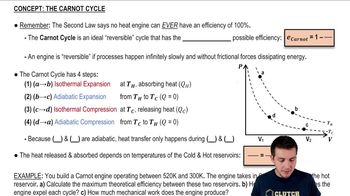
Carnot Cycle
Heat Transfer (Q)
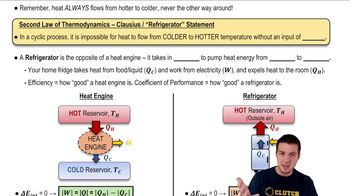
Coefficient of Performance (COP)
A freezer with a coefficient of performance 30% that of a Carnot refrigerator keeps the inside temperature at -22℃ in a 25℃ room. 3.0 L of water at 20℃ are placed in the freezer. How long does it take for the water to freeze if the freezer's compressor does work at the rate of 200 W while the water is freezing?
Home air conditioners in the United States have their power specified in the truly obscure units of tons, where 1 ton is the power needed to melt 1 ton (2000 lb or 910 kg) of ice in 24 hours. A modest-size house typically has a 4.0 ton air conditioner. If a 4.0 ton air conditioner has a coefficient of performance of 2.5, a typical value, at what rate in kW is heat energy removed from the house?
A typical coal-fired power plant burns 300 metric tons of coal every hour to generate 750 MW of electricity. 1 metric ton = 1000 kg. The density of coal is 1500 kg/m³ and its heat of combustion is 28 MJ/kg. Assume that all heat is transferred from the fuel to the boiler and that all the work done in spinning the turbine is transformed into electric energy. Suppose the coal is piled up in a 10 m ✕ 10 m room. How tall must the pile be to operate the plant for one day?
A Carnot heat engine operates between reservoirs at 182℃ and 0℃. If the engine extracts 25 J of energy from the hot reservoir per cycle, how many cycles will it take to lift a 10 kg mass a height of 10 m?
A Carnot engine operates between temperatures of 5℃ and 500℃. The output is used to run a Carnot refrigerator operating between -5℃ and 25℃. How many joules of heat energy does the refrigerator exhaust into the room for each joule of heat energy used by the heat engine?
