
Ch 21: Heat Engines and Refrigerators
Knight Calc - Physics for Scientists and Engineers 5th Edition
Knight Calc5th EditionPhysics for Scientists and EngineersISBN: 9780137344796Not the one you use?Change textbook
Chapter 21, Problem 48

Home air conditioners in the United States have their power specified in the truly obscure units of tons, where 1 ton is the power needed to melt 1 ton (2000 lb or 910 kg) of ice in 24 hours. A modest-size house typically has a 4.0 ton air conditioner. If a 4.0 ton air conditioner has a coefficient of performance of 2.5, a typical value, at what rate in kW is heat energy removed from the house?

Verified step by step guidance
1
Understand the problem: The air conditioner's power is given in tons, and we need to calculate the rate at which heat energy is removed from the house in kilowatts (kW). The coefficient of performance (COP) is also provided, which relates the heat energy removed to the work input.
Convert the power from tons to watts. Recall that 1 ton of cooling is equivalent to the power required to melt 1 ton of ice in 24 hours. This is equal to 3.517 kW. Therefore, a 4.0 ton air conditioner corresponds to \( 4.0 \times 3.517 \) kW.
Use the definition of the coefficient of performance (COP). The COP is defined as \( \text{COP} = \frac{Q_c}{W} \), where \( Q_c \) is the heat energy removed from the house (in watts) and \( W \) is the work input (in watts). Rearrange this equation to find \( Q_c \): \( Q_c = \text{COP} \times W \).
Relate the work input \( W \) to the cooling power of the air conditioner. The cooling power of the air conditioner (in watts) is equal to the work input \( W \) because the air conditioner operates at the given COP. Substitute \( W \) into the equation for \( Q_c \).
Finally, calculate \( Q_c \) in kilowatts by multiplying the COP (2.5) by the cooling power of the air conditioner (in kW). This gives the rate at which heat energy is removed from the house in kW.

Verified video answer for a similar problem:

This video solution was recommended by our tutors as helpful for the problem above.
Video duration:
4m
Was this helpful?

Key Concepts

Here are the essential concepts you must grasp in order to answer the question correctly.

Coefficient of Performance (COP)

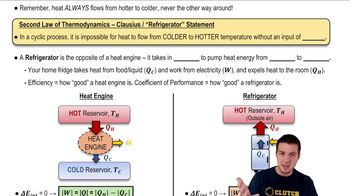
The Coefficient of Performance (COP) is a measure of the efficiency of a heating or cooling system. It is defined as the ratio of useful heating or cooling provided to the work input required. For air conditioners, a higher COP indicates better efficiency, meaning more heat is removed per unit of energy consumed. In this context, a COP of 2.5 means that for every unit of energy consumed, the air conditioner removes 2.5 units of heat.
Recommended video:
Guided course
06:47
Refrigerators

Tons of Refrigeration

Tons of refrigeration is a unit of power used to describe the cooling capacity of air conditioning systems. One ton is equivalent to the amount of heat required to melt one ton of ice in 24 hours, which is approximately 3.517 kW. This unit helps quantify the cooling power of air conditioners, making it easier to compare their capacities. A 4.0 ton air conditioner can thus remove heat at a rate of about 14.068 kW.
Recommended video:
Guided course
06:47
Refrigerators

Heat Transfer

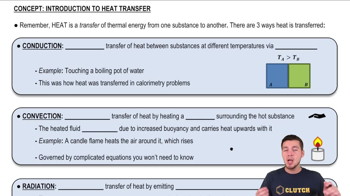
Heat transfer is the process of thermal energy moving from one object or substance to another due to a temperature difference. In the context of air conditioning, heat is removed from the indoor environment and transferred outside, effectively cooling the space. Understanding the principles of heat transfer, including conduction, convection, and radiation, is essential for analyzing how air conditioners operate and how efficiently they can maintain desired indoor temperatures.
Recommended video:
Guided course
05:14
Overview of Heat Transfer
Related Practice
Textbook Question

A car's internal combustion engine can be modeled as a heat engine operating between a combustion temperature of 1500℃ and an air temperature of 20℃ with 30% of the Carnot efficiency. The heat of combustion of gasoline is 47 kJ/g. What mass of gasoline is burned to accelerate a 1500 kg car from rest to a speed of 30 m/s?

2
views
Textbook Question

A typical coal-fired power plant burns 300 metric tons of coal every hour to generate 750 MW of electricity. 1 metric ton = 1000 kg. The density of coal is 1500 kg/m³ and its heat of combustion is 28 MJ/kg. Assume that all heat is transferred from the fuel to the boiler and that all the work done in spinning the turbine is transformed into electric energy. Suppose the coal is piled up in a 10 m ✕ 10 m room. How tall must the pile be to operate the plant for one day?

2
views
Textbook Question

FIGURE P21.46 shows a Carnot heat engine driving a Carnot refrigerator. Determine Q2, Q3 and Q4.

1
views
Textbook Question

A nuclear power plant generates 3000 MW of heat energy from nuclear reactions in the reactor's core. This energy is used to boil water and produce high-pressure steam at 300℃. The steam spins a turbine, which produces 1000 MW of electric power, then the steam is condensed and the water is cooled to 25℃ before starting the cycle again. What is the plant's actual efficiency?

1
views
Textbook Question

A Carnot heat engine operates between reservoirs at 182℃ and 0℃. If the engine extracts 25 J of energy from the hot reservoir per cycle, how many cycles will it take to lift a 10 kg mass a height of 10 m?

1
views
Textbook Question

A Carnot engine operates between temperatures of 5℃ and 500℃. The output is used to run a Carnot refrigerator operating between -5℃ and 25℃. How many joules of heat energy does the refrigerator exhaust into the room for each joule of heat energy used by the heat engine?

1
views