
Ch 21: Heat Engines and Refrigerators
Knight Calc - Physics for Scientists and Engineers 5th Edition
Knight Calc5th EditionPhysics for Scientists and EngineersISBN: 9780137344796Not the one you use?Change textbook
Chapter 21, Problem 39

A Carnot refrigerator operates between energy reservoirs at 0℃ and 250℃. A 2.4-cm-diameter, 50-cm-long copper bar connects the two energy reservoirs. At what rate, in W, must work be done on the refrigerator to remove heat from the cold reservoir at the same rate that it arrives through the copper bar?

Verified step by step guidance
1
Step 1: Convert the temperatures of the reservoirs from Celsius to Kelvin. Use the formula: \( T(K) = T(°C) + 273.15 \). For the cold reservoir, \( T_c = 0 + 273.15 \), and for the hot reservoir, \( T_h = 250 + 273.15 \).
Step 2: Calculate the thermal conductivity heat transfer rate through the copper bar using Fourier's law of heat conduction: \( Q = \frac{k A (T_h - T_c)}{L} \), where \( k \) is the thermal conductivity of copper (approximately 385 W/m·K), \( A \) is the cross-sectional area of the bar, \( T_h \) and \( T_c \) are the temperatures of the reservoirs, and \( L \) is the length of the bar. Compute \( A \) using the formula for the area of a circle: \( A = \pi r^2 \), where \( r \) is the radius of the bar (half the diameter).
Step 3: Use the Carnot efficiency formula to relate the work done on the refrigerator to the heat removed from the cold reservoir. The Carnot coefficient of performance (COP) for a refrigerator is given by \( \text{COP} = \frac{T_c}{T_h - T_c} \).
Step 4: Rearrange the COP formula to find the work done on the refrigerator: \( W = \frac{Q}{\text{COP}} \), where \( Q \) is the heat transfer rate calculated in Step 2, and \( \text{COP} \) is the Carnot coefficient of performance calculated in Step 3.
Step 5: Substitute the values of \( Q \) and \( \text{COP} \) into the formula from Step 4 to determine the rate at which work must be done on the refrigerator. Ensure all units are consistent (e.g., Watts for power).

Verified video answer for a similar problem:

This video solution was recommended by our tutors as helpful for the problem above.
Video duration:
10m
Was this helpful?

Key Concepts

Here are the essential concepts you must grasp in order to answer the question correctly.

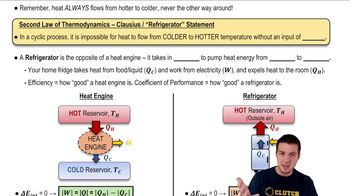
Carnot Refrigerator

A Carnot refrigerator is an idealized refrigeration cycle that operates between two thermal reservoirs. It is based on the second law of thermodynamics and provides the maximum possible efficiency for a refrigeration process. The performance of a Carnot refrigerator is determined by the temperatures of the hot and cold reservoirs, and it requires work input to transfer heat from the cold reservoir to the hot one.
Recommended video:
Guided course
06:47
Refrigerators

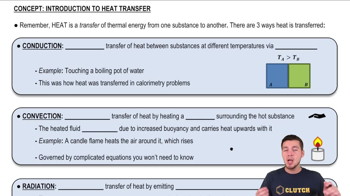
Heat Transfer through Conduction

Heat transfer through conduction is the process by which thermal energy moves through a material without the material itself moving. In this scenario, the copper bar conducts heat from the hot reservoir to the cold reservoir. The rate of heat transfer can be calculated using Fourier's law, which relates the heat transfer rate to the temperature difference and the material's thermal conductivity.
Recommended video:
Guided course
05:14
Overview of Heat Transfer

Work Input in Refrigeration Cycles

In refrigeration cycles, work input is the energy supplied to the system to facilitate the transfer of heat from the cold reservoir to the hot reservoir. The work done on the refrigerator must equal the heat absorbed from the cold reservoir minus the heat rejected to the hot reservoir. This relationship is crucial for determining the efficiency and operational requirements of the refrigeration system.
Recommended video:
Guided course
06:47
Refrigerators
Related Practice
Textbook Question

A freezer with a coefficient of performance 30% that of a Carnot refrigerator keeps the inside temperature at -22℃ in a 25℃ room. 3.0 L of water at 20℃ are placed in the freezer. How long does it take for the water to freeze if the freezer's compressor does work at the rate of 200 W while the water is freezing?

2
views
Textbook Question

An ideal refrigerator utilizes a Carnot cycle operating between 0℃ and 25℃. To turn 10 kg of liquid water at 0℃ into 10 kg of ice at 0℃, (a) how much heat is exhausted into the room and (b) how much energy must be supplied to the refrigerator?

2
views
Textbook Question

At what cold-reservoir temperature (in ℃) would a Carnot engine with a hot-reservoir temperature of 427℃ have an efficiency of 60%?

Textbook Question

A Carnot heat engine operates between reservoirs at 182℃ and 0℃. If the engine extracts 25 J of energy from the hot reservoir per cycle, how many cycles will it take to lift a 10 kg mass a height of 10 m?

1
views
Textbook Question

The engine that powers a crane burns fuel at a flame temperature of 2000℃. It is cooled by 20℃ air. The crane lifts a 2000 kg steel girder 30 m upward. How much heat energy is transferred to the engine by burning fuel if the engine is 40% as efficient as a Carnot engine?

1
views
Textbook Question

A Carnot engine whose hot-reservoir temperature is 400℃ has a thermal efficiency of 40%. By how many degrees should the temperature of the cold reservoir be decreased to raise the engine's efficiency to 60%?