Ch 21: Heat Engines and Refrigerators
Knight Calc - Physics for Scientists and Engineers 5th Edition
Knight Calc5th EditionPhysics for Scientists and EngineersISBN: 9780137344796Not the one you use?Change textbook
Chapter 21, Problem 21

The heat engine shown in FIGURE P21.62 uses 2.0 mol of a monatomic gas as the working substance.c. What is the engine's thermal efficiency?

Verified step by step guidance
1
Identify the type of cycle the heat engine is operating on (e.g., Carnot, Otto, etc.) and the properties of the working substance, which in this case is a monatomic gas.
Calculate the total heat absorbed (Q_in) by the engine during the heating part of the cycle. This can be done using the formula Q = nC_\(\Delta\) T, where n is the number of moles, C is the molar heat capacity at constant volume for a monatomic gas (3/2 R), and \(\Delta\) T is the change in temperature.
Calculate the total heat expelled (Q_out) by the engine during the cooling part of the cycle, using a similar approach as for Q_in.
Use the formula for thermal efficiency, \(\eta\) = 1 - \(\frac{Q_{out}\)}{Q_{in}}, to find the efficiency of the engine. Substitute the values of Q_out and Q_in obtained from the previous steps.
Interpret the result in terms of efficiency, considering that for real engines, the efficiency is always less than 1 (or 100%).

Verified video answer for a similar problem:

This video solution was recommended by our tutors as helpful for the problem above.
Video duration:
10m
Was this helpful?

Key Concepts

Here are the essential concepts you must grasp in order to answer the question correctly.

Thermal Efficiency

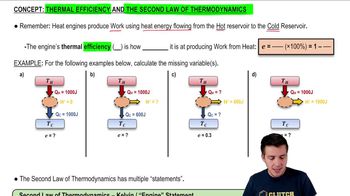
Thermal efficiency is a measure of how well a heat engine converts heat energy into work. It is defined as the ratio of the work output of the engine to the heat input from the hot reservoir. The efficiency can be expressed as a percentage, and higher efficiency indicates a more effective engine. For ideal engines, the maximum efficiency can be calculated using the Carnot efficiency formula, which depends on the temperatures of the hot and cold reservoirs.
Recommended video:
Guided course
06:01
Thermal Efficiency & The Second Law of Thermodynamics

First Law of Thermodynamics

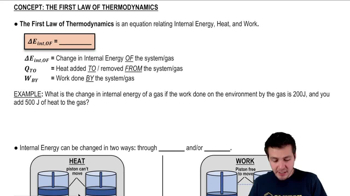
The First Law of Thermodynamics states that energy cannot be created or destroyed, only transformed from one form to another. In the context of a heat engine, this principle implies that the heat absorbed from the hot reservoir minus the work done by the engine equals the heat expelled to the cold reservoir. This law is fundamental in analyzing energy transfers and understanding how engines operate within the constraints of energy conservation.
Recommended video:
Guided course
08:04
The First Law of Thermodynamics

Monatomic Gas Behavior

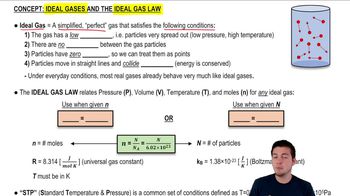
Monatomic gases consist of single atoms and exhibit specific thermodynamic properties, such as a distinct relationship between pressure, volume, and temperature described by the ideal gas law. For monatomic gases, the specific heat capacities at constant volume and pressure are well-defined, which influences the calculations of work done and heat transfer in thermodynamic processes. Understanding these properties is crucial for determining the performance of the heat engine using such gases.
Recommended video:
Guided course
07:21
Ideal Gases and the Ideal Gas Law