Ch 32: AC Circuits
Knight Calc - Physics for Scientists and Engineers 5th Edition
Knight Calc5th EditionPhysics for Scientists and EngineersISBN: 9780137344796Not the one you use?Change textbook
Chapter 32, Problem 49d

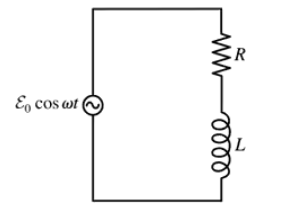
Use a phasor diagram to analyze the RL circuit of FIGURE P32.49. In particular, Find an expression for the crossover frequency ωc.

Verified step by step guidance
1
Identify the components of the RL circuit: The circuit consists of a resistor (R) and an inductor (L) connected in series. The total impedance of the circuit is the combination of the resistive and inductive reactance components.
Write the expression for the impedance of the RL circuit: The impedance \( Z \) is given by \( Z = \sqrt{R^2 + (\omega L)^2} \), where \( \omega \) is the angular frequency, \( R \) is the resistance, and \( L \) is the inductance.
Define the crossover frequency \( \omega_c \): The crossover frequency is the frequency at which the inductive reactance \( \omega L \) equals the resistance \( R \). This is the point where the magnitudes of the resistive and inductive components are equal.
Set up the equation for the crossover frequency: At \( \omega_c \), \( \omega_c L = R \). Solve for \( \omega_c \) to find \( \omega_c = \frac{R}{L} \).
Conclude with the expression for the crossover frequency: The crossover frequency \( \omega_c \) is determined by the ratio of the resistance \( R \) to the inductance \( L \), and is given by \( \omega_c = \frac{R}{L} \). This is the desired expression.

Verified video answer for a similar problem:

This video solution was recommended by our tutors as helpful for the problem above.
Was this helpful?

Key Concepts

Here are the essential concepts you must grasp in order to answer the question correctly.

Phasor Diagrams

Phasor diagrams are graphical representations of sinusoidal functions, where each phasor represents the amplitude and phase of a sinusoidal voltage or current. In the context of AC circuits, phasors simplify the analysis of circuit components like resistors, inductors, and capacitors by converting differential equations into algebraic equations. This allows for easier manipulation and understanding of the relationships between voltages and currents in the circuit.
Recommended video:

RL Circuit

An RL circuit consists of a resistor (R) and an inductor (L) connected in series or parallel. The behavior of an RL circuit is characterized by its impedance, which combines resistance and inductive reactance. The inductor's reactance increases with frequency, affecting the circuit's overall response to alternating current (AC) and leading to phenomena such as phase shifts between voltage and current.
Recommended video:

Crossover Frequency (ωc)

The crossover frequency (ωc) in an RL circuit is the frequency at which the inductive reactance equals the resistance, resulting in a specific phase relationship between voltage and current. At this frequency, the circuit transitions from being dominated by resistive behavior to inductive behavior. Understanding ωc is crucial for analyzing the frequency response of the circuit and determining how it will behave under different AC conditions.
Recommended video:
Guided course
05:08
Circumference, Period, and Frequency in UCM