A series RLC circuit consists of a 75 Ω resistor, a 0.12 H inductor, and a 30 μF capacitor. It is attached to a 120 V/60 Hz power line. What is the peak current I?
Ch 32: AC Circuits
Knight Calc5th EditionPhysics for Scientists and EngineersISBN: 9780137344796Not the one you use?Change textbook
Chapter 32, Problem 50
A series RL circuit is built with a 110 Ω resistor and a 5.0-cm-long, 1.0-cm-diameter solenoid with 800 turns of wire. What is the peak magnetic flux through the solenoid if the circuit is driven by a 12 V, 5.0 kHz source?
Verified step by step guidance1
Step 1: Calculate the inductance of the solenoid using the formula for inductance of a solenoid: \( L = \mu_0 \frac{N^2 A}{l} \), where \( \mu_0 \) is the permeability of free space \( (4\pi \times 10^{-7} \ \text{H/m}) \), \( N \) is the number of turns, \( A \) is the cross-sectional area of the solenoid \( (\pi r^2) \), and \( l \) is the length of the solenoid.
Step 2: Determine the impedance of the RL circuit using the formula \( Z = \sqrt{R^2 + (\omega L)^2} \), where \( R \) is the resistance, \( \omega \) is the angular frequency \( (2\pi f) \), and \( L \) is the inductance calculated in Step 1.
Step 3: Calculate the peak current in the circuit using Ohm's law for AC circuits: \( I_{\text{peak}} = \frac{V_{\text{peak}}}{Z} \), where \( V_{\text{peak}} \) is the peak voltage of the source \( (\sqrt{2} \times V_{\text{rms}}) \) and \( Z \) is the impedance from Step 2.
Step 4: Compute the peak magnetic flux through the solenoid using the formula \( \Phi_{\text{peak}} = L \cdot I_{\text{peak}} \), where \( L \) is the inductance from Step 1 and \( I_{\text{peak}} \) is the peak current from Step 3.
Step 5: Ensure all units are consistent throughout the calculations (e.g., convert cm to meters for length and diameter) and verify the final expression for \( \Phi_{\text{peak}} \) is dimensionally correct.

Verified video answer for a similar problem:
This video solution was recommended by our tutors as helpful for the problem above.
Video duration:
9mWas this helpful?
Key Concepts
Here are the essential concepts you must grasp in order to answer the question correctly.
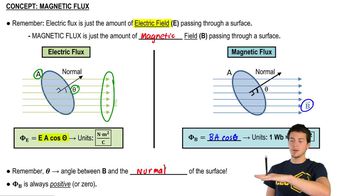
Magnetic Flux
Magnetic flux is a measure of the quantity of magnetism, taking into account the strength and the extent of a magnetic field. It is defined as the product of the magnetic field (B) and the area (A) through which the field lines pass, given by the formula Φ = B · A. In the context of a solenoid, the magnetic field inside it can be calculated using the formula B = μ₀(nI), where μ₀ is the permeability of free space, n is the number of turns per unit length, and I is the current.
Recommended video:
Guided course
Magnetic Flux
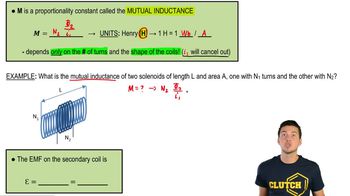
Inductance in RL Circuits
Inductance is a property of an electrical circuit that opposes changes in current. In an RL circuit, which consists of a resistor (R) and an inductor (L), the inductor stores energy in a magnetic field when current flows through it. The inductance affects how quickly the current can change in response to an applied voltage, and it plays a crucial role in determining the behavior of the circuit when driven by an alternating current (AC) source.
Recommended video:
Guided course
Mutual Induction
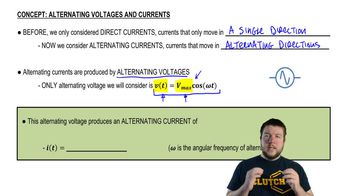
AC Voltage and Frequency
Alternating current (AC) voltage is characterized by its periodic change in magnitude and direction, typically described by its frequency, measured in hertz (Hz). In this question, the circuit is driven by a 5.0 kHz AC source, meaning the voltage oscillates 5000 times per second. The frequency affects the inductive reactance of the circuit, which influences the current flowing through the circuit and, consequently, the magnetic field generated in the solenoid.
Recommended video:
Guided course
Alternating Voltages and Currents
Related Practice
Textbook Question
1
views
Textbook Question
A series RLC circuit consists of a 75 Ω resistor, a 0.12 H inductor, and a 30 μF capacitor. It is attached to a 120 V/60 Hz power line. What is the phase angle ϕ?
Textbook Question
Use a phasor diagram to analyze the RL circuit of FIGURE P32.49. In particular, What is VR in the limits ω→0 and ω→∞?
Textbook Question
Use a phasor diagram to analyze the RL circuit of FIGURE P32.49. In particular, Find an expression for the crossover frequency ωc.
1
views
Textbook Question
A series RLC circuit consists of a 75 Ω resistor, a 0.12 H inductor, and a 30 μF capacitor. It is attached to a 120 V/60 Hz power line. What is the average power dissipated?
Textbook Question
Use a phasor diagram to analyze the RL circuit of FIGURE P32.49. In particular, Find expressions for I, VR, and VL.
2
views