Ch 32: AC Circuits
Knight Calc - Physics for Scientists and Engineers 5th Edition
Knight Calc5th EditionPhysics for Scientists and EngineersISBN: 9780137344796Not the one you use?Change textbook
Chapter 32, Problem 51c

A series RLC circuit consists of a 75 Ω resistor, a 0.12 H inductor, and a 30 μF capacitor. It is attached to a 120 V/60 Hz power line. What is the average power dissipated?

Verified step by step guidance
1
Step 1: Calculate the angular frequency (ω) of the AC power source using the formula ω = 2πf, where f is the frequency of the power line. For this problem, f = 60 Hz.
Step 2: Determine the inductive reactance (X_L) using the formula X_L = ωL, where L is the inductance of the inductor (0.12 H).
Step 3: Calculate the capacitive reactance (X_C) using the formula X_C = 1 / (ωC), where C is the capacitance of the capacitor (30 μF or 30 × 10⁻⁶ F).
Step 4: Compute the total impedance (Z) of the circuit using the formula Z = √(R² + (X_L - X_C)²), where R is the resistance (75 Ω).
Step 5: Calculate the average power dissipated using the formula P_avg = (V_rms² / Z) × (R / Z), where V_rms is the root mean square voltage of the power source (120 V).

Verified video answer for a similar problem:

This video solution was recommended by our tutors as helpful for the problem above.
Video duration:
10m
Was this helpful?

Key Concepts

Here are the essential concepts you must grasp in order to answer the question correctly.

Impedance in RLC Circuits

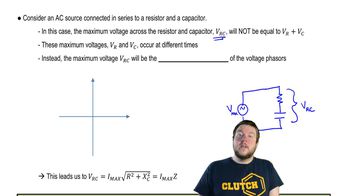
Impedance is the total opposition that a circuit offers to the flow of alternating current (AC) and is represented as a complex number. In a series RLC circuit, the impedance combines the resistance (R), inductive reactance (XL), and capacitive reactance (XC). The formula for impedance is Z = √(R² + (XL - XC)²), where XL = 2πfL and XC = 1/(2πfC). Understanding impedance is crucial for calculating current and power in AC circuits.
Recommended video:
Guided course
08:40
Impedance in AC Circuits

Average Power in AC Circuits

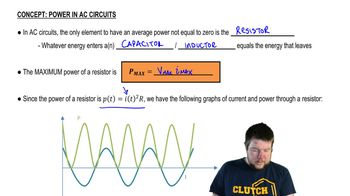
The average power dissipated in an AC circuit is calculated using the formula P = VIcos(φ), where V is the root mean square (RMS) voltage, I is the RMS current, and φ is the phase angle between the voltage and current. The phase angle is determined by the impedance of the circuit and affects how much of the power is actually used for work versus being stored in the reactive components. This concept is essential for determining how much power is effectively consumed by the circuit.
Recommended video:
Guided course
05:37
Power in AC Circuits

Resonance in RLC Circuits

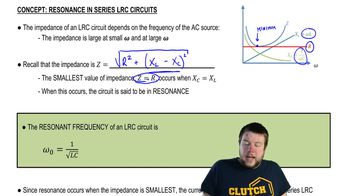
Resonance occurs in RLC circuits when the inductive reactance equals the capacitive reactance (XL = XC), resulting in maximum current flow and minimal impedance. At resonance, the circuit can draw maximum power from the source, and the phase angle φ becomes zero, meaning the voltage and current are in phase. While this concept is not directly needed for calculating average power, it provides insight into the behavior of the circuit under different frequencies, which can affect power dissipation.
Recommended video:
Guided course
05:23
Resonance in Series LRC Circuits