Ch 32: AC Circuits
Knight Calc - Physics for Scientists and Engineers 5th Edition
Knight Calc5th EditionPhysics for Scientists and EngineersISBN: 9780137344796Not the one you use?Change textbook
Chapter 32, Problem 58

Show that the power factor of a series RLC circuit is cos ϕ=R/Z.

Verified step by step guidance
1
Start by understanding the power factor in an AC circuit. The power factor is defined as the cosine of the phase angle (ϕ) between the voltage and the current in the circuit. Mathematically, it is expressed as cos(ϕ).
In a series RLC circuit, the total impedance (Z) is given by the formula: Z = √(R² + (XL - XC)²), where R is the resistance, XL is the inductive reactance, and XC is the capacitive reactance.
The phase angle (ϕ) in a series RLC circuit is determined by the relationship between the resistive and reactive components of the impedance. Specifically, tan(ϕ) = (XL - XC) / R.
The power factor is the cosine of this phase angle, so cos(ϕ) = adjacent / hypotenuse in the impedance triangle. Here, the adjacent side corresponds to R (resistance), and the hypotenuse corresponds to Z (total impedance). Thus, cos(ϕ) = R / Z.
Conclude by noting that the power factor of a series RLC circuit is indeed cos(ϕ) = R / Z, as derived from the relationship between the resistive and total impedance components.

Verified video answer for a similar problem:

This video solution was recommended by our tutors as helpful for the problem above.
Was this helpful?

Key Concepts

Here are the essential concepts you must grasp in order to answer the question correctly.

Power Factor

The power factor is a dimensionless number between -1 and 1 that represents the ratio of real power flowing to the load to the apparent power in the circuit. It indicates how effectively electrical power is being converted into useful work output. A power factor of 1 (or 100%) signifies that all the power is being effectively converted, while a lower power factor indicates inefficiencies.
Recommended video:

Impedance (Z)

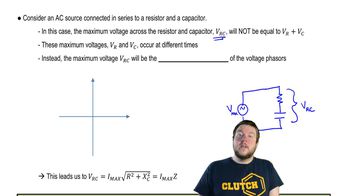
Impedance is the total opposition that a circuit offers to the flow of alternating current (AC) and is represented as a complex number. It combines both resistance (R) and reactance (X), where reactance arises from inductors and capacitors in the circuit. The magnitude of impedance is crucial for calculating the power factor, as it determines how much current flows for a given voltage.
Recommended video:
Guided course
08:40
Impedance in AC Circuits

Phase Angle (ϕ)

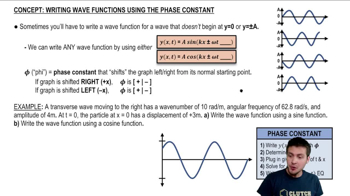
The phase angle (ϕ) in an RLC circuit represents the phase difference between the voltage across the circuit and the current flowing through it. It is a critical factor in determining the power factor, as it affects how much of the total power is being used effectively. The cosine of the phase angle (cos ϕ) directly relates to the power factor, illustrating the relationship between resistance and impedance.
Recommended video:
Guided course
08:59
Phase Constant of a Wave Function
Related Practice
Textbook Question

A television channel is assigned the frequency range from 54 MHz to 60 MHz. A series RLC tuning circuit in a TV receiver resonates in the middle of this frequency range. The circuit uses a 16 pF capacitor. What is the value of the inductor?

1
views
Textbook Question

The tuning circuit in an FM radio receiver is a series RLC circuit with a 0.200 μH inductor. The receiver is tuned to a station at 104.3 MHz. What is the value of the capacitor in the tuning circuit?

2
views
Textbook Question

The tuning circuit in an FM radio receiver is a series RLC circuit with a 0.200 μH inductor. FM radio stations are assigned frequencies every 0.2 MHz, but two nearby stations cannot use adjacent frequencies. What is the maximum resistance the tuning circuit can have if the peak current at a frequency of 103.9 MHz, the closest frequency that can be used by a nearby station, is to be no more than 0.10% of the peak current at 104.3 MHz? The radio is still tuned to 104.3 MHz, and you can assume the two stations have equal strength.

2
views
Textbook Question

A series RLC circuit consists of a 75 Ω resistor, a 0.12 H inductor, and a 30 μF capacitor. It is attached to a 120 V/60 Hz power line. What is the average power dissipated?

Textbook Question

In FIGURE P32.54, what is the current supplied by the emf when (a) the frequency is very small and (b) the frequency is very large?

2
views
Textbook Question

A series RLC circuit consists of a 50 Ω resistor, a 3.3 mH inductor, and a 480 nF capacitor. It is connected to a 5.0 kHz oscillator with a peak voltage of 5.0 V. What is the instantaneous current i when ε = ε0?

2
views