Ch 32: AC Circuits
Knight Calc - Physics for Scientists and Engineers 5th Edition
Knight Calc5th EditionPhysics for Scientists and EngineersISBN: 9780137344796Not the one you use?Change textbook
Chapter 32, Problem 60b

The tuning circuit in an FM radio receiver is a series RLC circuit with a 0.200 μH inductor. FM radio stations are assigned frequencies every 0.2 MHz, but two nearby stations cannot use adjacent frequencies. What is the maximum resistance the tuning circuit can have if the peak current at a frequency of 103.9 MHz, the closest frequency that can be used by a nearby station, is to be no more than 0.10% of the peak current at 104.3 MHz? The radio is still tuned to 104.3 MHz, and you can assume the two stations have equal strength.

Verified step by step guidance
1
Step 1: Understand the problem. The tuning circuit is a series RLC circuit, and the goal is to determine the maximum resistance such that the peak current at 103.9 MHz is no more than 0.10% of the peak current at 104.3 MHz. This involves analyzing the frequency response of the circuit and the relationship between current and impedance.
Step 2: Write the formula for the impedance of a series RLC circuit. The impedance \( Z \) is given by: \( Z = \sqrt{R^2 + \left( \omega L - \frac{1}{\omega C} \right)^2} \), where \( \omega = 2 \pi f \) is the angular frequency, \( L \) is the inductance, \( C \) is the capacitance, and \( R \) is the resistance.
Step 3: Relate the current to the impedance. The peak current \( I \) is inversely proportional to the impedance: \( I = \frac{V}{Z} \), where \( V \) is the peak voltage. Since the problem specifies the ratio of currents at two frequencies, you can use the ratio of impedances to find the maximum resistance.
Step 4: Calculate the angular frequencies for 104.3 MHz and 103.9 MHz. Use \( \omega = 2 \pi f \), where \( f \) is the frequency in Hz. Convert MHz to Hz by multiplying by \( 10^6 \). For example, \( \omega_{104.3} = 2 \pi \times 104.3 \times 10^6 \). Perform similar calculations for \( \omega_{103.9} \).
Step 5: Set up the ratio of currents and solve for \( R \). The problem states that \( I_{103.9} \leq 0.001 \times I_{104.3} \). Substitute \( I = \frac{V}{Z} \) into this inequality, and express \( Z \) in terms of \( R \), \( L \), \( C \), and \( \omega \). Solve the inequality for \( R \), ensuring that the resistance satisfies the condition for the given frequencies.

Verified video answer for a similar problem:

This video solution was recommended by our tutors as helpful for the problem above.
Video duration:
15m
Was this helpful?

Key Concepts

Here are the essential concepts you must grasp in order to answer the question correctly.

RLC Circuit

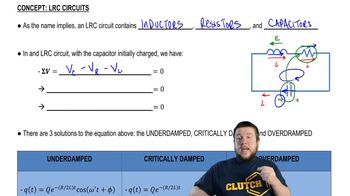
An RLC circuit consists of a resistor (R), inductor (L), and capacitor (C) connected in series or parallel. It is fundamental in understanding how circuits can resonate at specific frequencies, which is crucial for tuning in radio frequencies. The behavior of the circuit is characterized by its impedance, which varies with frequency, affecting the current and voltage across each component.
Recommended video:

Resonance Frequency

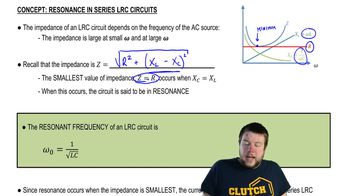
The resonance frequency of an RLC circuit is the frequency at which the inductive and capacitive reactances are equal in magnitude, resulting in maximum current flow. This frequency is determined by the values of the inductor and capacitor in the circuit. For FM radio, tuning to the resonance frequency allows the circuit to effectively select a specific station while minimizing interference from others.
Recommended video:
Guided course
05:23
Resonance in Series LRC Circuits

Quality Factor (Q)

The quality factor (Q) of an RLC circuit measures its selectivity and bandwidth. A higher Q indicates a narrower bandwidth and better selectivity, meaning the circuit can distinguish between closely spaced frequencies. In the context of the FM radio question, the Q factor is essential for determining the maximum resistance allowable in the circuit to maintain the desired peak current at the tuned frequency while avoiding interference from nearby stations.
Recommended video:
Guided course
04:32
Dielectric Breakdown
Related Practice
Textbook Question

A television channel is assigned the frequency range from 54 MHz to 60 MHz. A series RLC tuning circuit in a TV receiver resonates in the middle of this frequency range. The circuit uses a 16 pF capacitor. What is the value of the inductor?

1
views
Textbook Question

The tuning circuit in an FM radio receiver is a series RLC circuit with a 0.200 μH inductor. The receiver is tuned to a station at 104.3 MHz. What is the value of the capacitor in the tuning circuit?

2
views
Textbook Question

Commercial electricity is generated and transmitted as three-phase electricity. Instead of a single emf, three separate wires carry currents for the emfs ε1 = ε0 cos ωt, ε2 = ε0 cos(ωt +120°), and ε3 = ε0 cos(ωt−120°) over three parallel wires, each of which supplies one-third of the power. This is why the long-distance transmission lines you see in the countryside have three wires. Suppose the transmission lines into a city supply a total of 450 MW of electric power, a realistic value. What would be the rms current in each wire if the transmission voltage were ε0 = 120 V rms?

2
views
Textbook Question

A series RLC circuit consists of a 50 Ω resistor, a 3.3 mH inductor, and a 480 nF capacitor. It is connected to a 5.0 kHz oscillator with a peak voltage of 5.0 V. What is the instantaneous current i when ε = ε0?

2
views
Textbook Question

Commercial electricity is generated and transmitted as three-phase electricity. Instead of a single emf, three separate wires carry currents for the emfs ε1 = ε0 cos ωt, ε2 = ε0 cos(ωt +120°), and ε3 = ε0 cos(ωt−120°) over three parallel wires, each of which supplies one-third of the power. This is why the long-distance transmission lines you see in the countryside have three wires. Suppose the transmission lines into a city supply a total of 450 MW of electric power, a realistic value. In fact, transformers are used to step the transmission-line voltage up to 500 kV rms. What is the current in each wire?

1
views
Textbook Question

Show that the power factor of a series RLC circuit is cos ϕ=R/Z.

1
views