Ch 32: AC Circuits
Knight Calc - Physics for Scientists and Engineers 5th Edition
Knight Calc5th EditionPhysics for Scientists and EngineersISBN: 9780137344796Not the one you use?Change textbook
Chapter 32, Problem 61a

A television channel is assigned the frequency range from 54 MHz to 60 MHz. A series RLC tuning circuit in a TV receiver resonates in the middle of this frequency range. The circuit uses a 16 pF capacitor. What is the value of the inductor?

Verified step by step guidance
1
Identify the middle frequency of the given range. The middle frequency is the average of the lower and upper frequencies: \( f_{\text{mid}} = \frac{f_{\text{low}} + f_{\text{high}}}{2} \). Here, \( f_{\text{low}} = 54 \, \text{MHz} \) and \( f_{\text{high}} = 60 \, \text{MHz} \).
Use the resonance condition for an RLC circuit: \( f_{\text{res}} = \frac{1}{2 \pi \sqrt{L C}} \), where \( f_{\text{res}} \) is the resonant frequency, \( L \) is the inductance, and \( C \) is the capacitance. Substitute \( f_{\text{res}} = f_{\text{mid}} \) and \( C = 16 \, \text{pF} = 16 \times 10^{-12} \; \text{F} \).
Rearrange the resonance formula to solve for the inductance \( L \): \( L = \frac{1}{(2 \pi f_{\text{res}})^2 C} \).
Substitute the values of \( f_{\text{res}} \) (calculated in step 1) and \( C \) into the formula for \( L \). Ensure that \( f_{\text{res}} \) is converted to hertz (\( \text{Hz} \)) by multiplying the value in megahertz (\( \text{MHz} \)) by \( 10^6 \).
Simplify the expression to find the value of \( L \). The result will be in henries (\( \text{H} \)).

Verified video answer for a similar problem:

This video solution was recommended by our tutors as helpful for the problem above.
Video duration:
5m
Was this helpful?

Key Concepts

Here are the essential concepts you must grasp in order to answer the question correctly.

Resonance in RLC Circuits

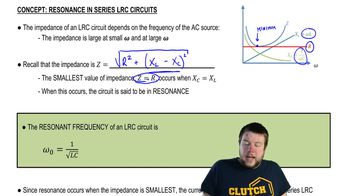
Resonance occurs in an RLC circuit when the inductive reactance equals the capacitive reactance, allowing the circuit to oscillate at a specific frequency. This frequency, known as the resonant frequency, can be calculated using the formula f = 1/(2π√(LC)), where L is the inductance and C is the capacitance. At resonance, the circuit can efficiently transfer energy, making it crucial for tuning applications like television receivers.
Recommended video:
Guided course
05:23
Resonance in Series LRC Circuits

Inductive Reactance

Inductive reactance (XL) is the opposition that an inductor presents to alternating current (AC) due to its inductance. It is calculated using the formula XL = 2πfL, where f is the frequency and L is the inductance. Understanding inductive reactance is essential for determining how the inductor will behave in the circuit at the resonant frequency, impacting the overall performance of the tuning circuit.
Recommended video:
Guided course
12:59
Mutual Induction

Capacitance

Capacitance is the ability of a capacitor to store electrical energy in an electric field, measured in farads (F). In this context, the circuit uses a 16 pF capacitor, which indicates its ability to store charge. The capacitance value is critical in determining the resonant frequency of the RLC circuit, as it directly influences the calculations for the required inductance to achieve resonance within the specified frequency range.
Recommended video:
Guided course
08:02
Capacitors & Capacitance (Intro)
Related Practice
Textbook Question

The tuning circuit in an FM radio receiver is a series RLC circuit with a 0.200 μH inductor. The receiver is tuned to a station at 104.3 MHz. What is the value of the capacitor in the tuning circuit?

2
views

Textbook Question

The tuning circuit in an FM radio receiver is a series RLC circuit with a 0.200 μH inductor. FM radio stations are assigned frequencies every 0.2 MHz, but two nearby stations cannot use adjacent frequencies. What is the maximum resistance the tuning circuit can have if the peak current at a frequency of 103.9 MHz, the closest frequency that can be used by a nearby station, is to be no more than 0.10% of the peak current at 104.3 MHz? The radio is still tuned to 104.3 MHz, and you can assume the two stations have equal strength.

2
views
Textbook Question

A generator consists of a 12-cm by 16-cm rectangular loop with 500 turns of wire spinning at 60 Hz in a 25 mT uniform magnetic field. The generator output is connected to a series RC circuit consisting of a 120 Ω resistor and a 35 μF capacitor. What is the average power delivered to the circuit?

2
views
Textbook Question

Commercial electricity is generated and transmitted as three-phase electricity. Instead of a single emf, three separate wires carry currents for the emfs ε1 = ε0 cos ωt, ε2 = ε0 cos(ωt +120°), and ε3 = ε0 cos(ωt−120°) over three parallel wires, each of which supplies one-third of the power. This is why the long-distance transmission lines you see in the countryside have three wires. Suppose the transmission lines into a city supply a total of 450 MW of electric power, a realistic value. What would be the rms current in each wire if the transmission voltage were ε0 = 120 V rms?

2
views
Textbook Question

Commercial electricity is generated and transmitted as three-phase electricity. Instead of a single emf, three separate wires carry currents for the emfs ε1 = ε0 cos ωt, ε2 = ε0 cos(ωt +120°), and ε3 = ε0 cos(ωt−120°) over three parallel wires, each of which supplies one-third of the power. This is why the long-distance transmission lines you see in the countryside have three wires. Suppose the transmission lines into a city supply a total of 450 MW of electric power, a realistic value. In fact, transformers are used to step the transmission-line voltage up to 500 kV rms. What is the current in each wire?

1
views
Textbook Question

Show that the power factor of a series RLC circuit is cos ϕ=R/Z.

1
views