
Ch 32: AC Circuits
Knight Calc - Physics for Scientists and Engineers 5th Edition
Knight Calc5th EditionPhysics for Scientists and EngineersISBN: 9780137344796Not the one you use?Change textbook
Chapter 32, Problem 49a

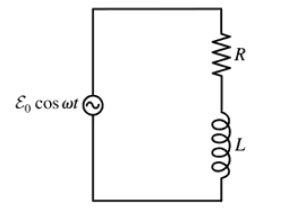
Use a phasor diagram to analyze the RL circuit of FIGURE P32.49. In particular, Find expressions for I, VR, and VL.

Verified step by step guidance
1
Step 1: Understand the components of the RL circuit. An RL circuit consists of a resistor (R) and an inductor (L) connected in series with an alternating current (AC) source. The current (I) is the same through both components, but the voltage across the resistor (V_R) and the inductor (V_L) will differ in phase due to the inductive reactance.
Step 2: Represent the voltages and current as phasors. In an RL circuit, the voltage across the resistor (V_R) is in phase with the current (I), while the voltage across the inductor (V_L) leads the current by 90 degrees. Use a phasor diagram to represent these relationships, with the current phasor as the reference (horizontal axis).
Step 3: Write the expressions for the voltages. The voltage across the resistor is given by \( V_R = I R \), where \( R \) is the resistance. The voltage across the inductor is given by \( V_L = I X_L \), where \( X_L = \omega L \) is the inductive reactance, and \( \omega \) is the angular frequency of the AC source.
Step 4: Use the phasor diagram to find the total voltage. The total voltage \( V \) is the vector sum of \( V_R \) and \( V_L \). Since \( V_R \) and \( V_L \) are perpendicular, the magnitude of the total voltage is \( V = \sqrt{V_R^2 + V_L^2} \). Substitute the expressions for \( V_R \) and \( V_L \) to get \( V = \sqrt{(I R)^2 + (I X_L)^2} \).
Step 5: Solve for the current \( I \). The current can be expressed as \( I = \frac{V}{\sqrt{R^2 + X_L^2}} \). Once \( I \) is known, substitute it back into the expressions for \( V_R \) and \( V_L \) to find their respective values. This completes the analysis of the RL circuit using a phasor diagram.

Verified video answer for a similar problem:

This video solution was recommended by our tutors as helpful for the problem above.
Was this helpful?

Key Concepts

Here are the essential concepts you must grasp in order to answer the question correctly.

Phasor Diagrams

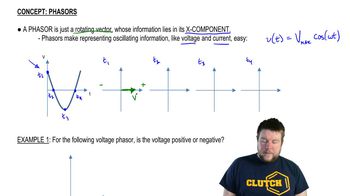
Phasor diagrams are graphical representations of sinusoidal functions, where each phasor represents the amplitude and phase of a sinusoidal voltage or current. In the context of AC circuits, phasors simplify the analysis of circuit elements by converting time-dependent sinusoidal signals into complex numbers, allowing for easier calculations of voltages and currents in the circuit.
Recommended video:

RL Circuit

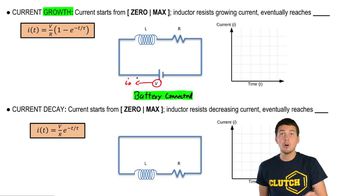
An RL circuit consists of a resistor (R) and an inductor (L) connected in series or parallel. The behavior of an RL circuit is characterized by its impedance, which combines resistance and inductive reactance. The inductor introduces a phase shift between the voltage and current, affecting the overall circuit response to alternating current (AC) signals, which is crucial for determining the expressions for current and voltages across the components.
Recommended video:

Impedance

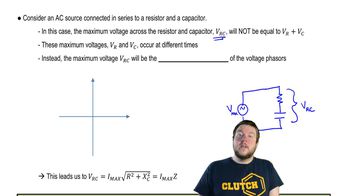
Impedance is a measure of how much a circuit resists the flow of alternating current, combining both resistance (R) and reactance (X). In an RL circuit, the impedance is given by Z = R + jωL, where j is the imaginary unit and ω is the angular frequency of the AC source. Understanding impedance is essential for calculating the current (I) and the voltages across the resistor (VR) and inductor (VL) using Ohm's law and Kirchhoff's laws in the phasor domain.
Recommended video:
Guided course
08:40
Impedance in AC Circuits