Ch 32: AC Circuits
Knight Calc - Physics for Scientists and Engineers 5th Edition
Knight Calc5th EditionPhysics for Scientists and EngineersISBN: 9780137344796Not the one you use?Change textbook
Chapter 32, Problem 48

The small transformers that power many consumer products produce a 12.0 V rms, 60 Hz emf. Design a circuit using resistors and capacitors that uses the transformer voltage as an input and produces a 6.0 V rms output that leads the input voltage by 45°.

Verified step by step guidance
1
Step 1: Understand the problem requirements. The circuit needs to reduce the rms voltage from 12.0 V to 6.0 V and ensure the output voltage leads the input voltage by 45°. This suggests the use of a combination of resistors and capacitors to create a phase shift and voltage divider effect.
Step 2: Use the concept of a voltage divider. In an RC circuit, the voltage across the capacitor and resistor can be divided based on their impedance. The impedance of a resistor is R, and the impedance of a capacitor is given by \( Z_C = \frac{1}{\omega C} \), where \( \omega = 2 \pi f \) is the angular frequency and \( C \) is the capacitance.
Step 3: Calculate the angular frequency \( \omega \) using the given frequency \( f = 60 \text{ Hz} \). The formula is \( \omega = 2 \pi f \). Substitute \( f \) to find \( \omega \).
Step 4: Design the circuit to achieve the desired phase shift of 45°. In an RC circuit, the phase angle \( \phi \) between the input and output voltage is given by \( \tan \phi = \frac{X_C}{R} \), where \( X_C = \frac{1}{\omega C} \). Set \( \phi = 45° \) and solve for the relationship between \( R \) and \( C \).
Step 5: Ensure the voltage divider produces the desired rms output voltage of 6.0 V. The output voltage \( V_{out} \) in an RC circuit is given by \( V_{out} = V_{in} \cdot \frac{Z_C}{\sqrt{R^2 + Z_C^2}} \). Substitute \( V_{in} = 12.0 \text{ V rms} \), \( Z_C = \frac{1}{\omega C} \), and the relationship between \( R \) and \( C \) from Step 4 to solve for the values of \( R \) and \( C \).

Verified video answer for a similar problem:

This video solution was recommended by our tutors as helpful for the problem above.
Video duration:
9m
Was this helpful?

Key Concepts

Here are the essential concepts you must grasp in order to answer the question correctly.

RMS Voltage

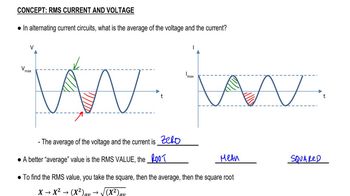
RMS (Root Mean Square) voltage is a way of expressing the effective value of an alternating current (AC) voltage. It represents the equivalent DC voltage that would deliver the same power to a load. In this question, the transformer produces a 12.0 V rms output, which is crucial for understanding how to design the circuit to achieve a desired output voltage.
Recommended video:
Guided course
07:14
RMS Current and Voltage

Phase Angle

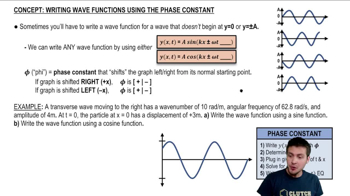
The phase angle in an AC circuit indicates the difference in phase between the voltage and current waveforms. A phase angle of 45° means that the output voltage leads the input voltage by a quarter of a cycle. This concept is essential for designing the circuit to ensure that the output voltage not only has the correct magnitude (6.0 V rms) but also the correct phase relationship with respect to the input voltage.
Recommended video:
Guided course
08:59
Phase Constant of a Wave Function

RC Circuit

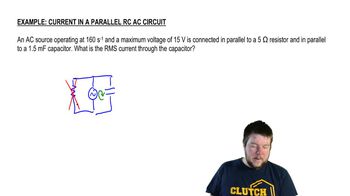
An RC circuit consists of resistors (R) and capacitors (C) and is commonly used to filter signals or create phase shifts. In this scenario, the design of the circuit will involve selecting appropriate resistor and capacitor values to achieve the desired output voltage and phase shift. The interaction between the resistance and capacitance determines the circuit's impedance and phase characteristics, which are critical for meeting the specifications of the problem.
Recommended video:
Guided course
03:45
Current in a Parallel RC AC Circuit