Ch 30: Electromagnetic Induction
Knight Calc - Physics for Scientists and Engineers 5th Edition
Knight Calc5th EditionPhysics for Scientists and EngineersISBN: 9780137344796Not the one you use?Change textbook
Chapter 30, Problem 76b

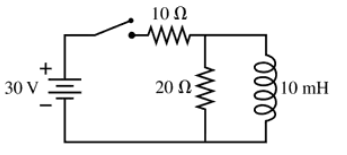
The switch in FIGURE P30.76 has been open for a long time. It is closed at t = 0 s. What is the current through the 20 Ω resistor after the switch has been closed a long time?

Verified step by step guidance
1
Step 1: Analyze the circuit components. The circuit consists of a 30 V battery, a 10 Ω resistor, a 20 Ω resistor, and a 10 mH inductor. The switch has been open for a long time, meaning the inductor has no initial current flowing through it.
Step 2: Understand the behavior of the inductor. After the switch is closed for a long time, the inductor reaches a steady state where it acts like a short circuit (its impedance becomes negligible). This simplifies the circuit to a series-parallel resistor network.
Step 3: Simplify the circuit. In the steady state, the inductor is replaced by a wire (short circuit). The 20 Ω resistor is in parallel with the short circuit, effectively removing it from the circuit because the current prefers the path of least resistance (the short circuit). The remaining circuit consists of the 30 V battery and the 10 Ω resistor.
Step 4: Calculate the current through the 10 Ω resistor. Using Ohm's Law, \( I = \frac{V}{R} \), where \( V \) is the voltage across the resistor and \( R \) is its resistance. Substitute \( V = 30 \, \text{V} \) and \( R = 10 \, \Omega \).
Step 5: Conclude that the current through the 20 Ω resistor is zero after the switch has been closed for a long time, as the inductor bypasses it completely in the steady state.

Verified video answer for a similar problem:

This video solution was recommended by our tutors as helpful for the problem above.
Was this helpful?

Key Concepts

Here are the essential concepts you must grasp in order to answer the question correctly.

Ohm's Law

Ohm's Law states that the current (I) flowing through a conductor between two points is directly proportional to the voltage (V) across the two points and inversely proportional to the resistance (R) of the conductor. This relationship is expressed mathematically as I = V/R. Understanding this law is crucial for analyzing circuits, as it allows us to calculate the current through resistors when a voltage is applied.
Recommended video:
Guided course
03:07
Resistance and Ohm's Law

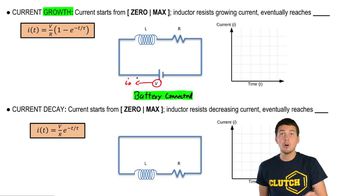
Steady State in RL Circuits

In an RL circuit, when a switch is closed, the inductor initially opposes changes in current due to its inductance. However, after a long time, the inductor behaves like a short circuit, allowing the current to stabilize. In steady state, the inductor does not affect the current flow, and the circuit can be analyzed using only the resistances present, simplifying calculations for current through resistors.
Recommended video:

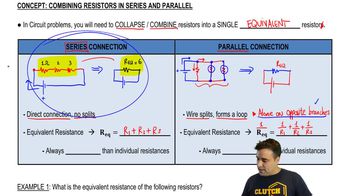
Series and Parallel Resistor Combinations

In electrical circuits, resistors can be arranged in series or parallel configurations. In a series circuit, the total resistance is the sum of individual resistances, while in a parallel circuit, the total resistance can be found using the formula 1/R_total = 1/R1 + 1/R2 + ... + 1/Rn. Understanding these combinations is essential for determining the overall resistance in a circuit, which directly affects the current flowing through each component.
Recommended video:
Guided course
12:42
Combining Resistors in Series & Parallel
Related Practice
Textbook Question

An electric oscillator is made with a 0.10 μF capacitor and a 1.0 mH inductor. The capacitor is initially charged to 5.0 V. What is the maximum current through the inductor as the circuit oscillates?

1
views

Textbook Question

The switch in FIGURE P30.76 has been open for a long time. It is closed at t = 0 s. What is the current through the 20 Ω resistor immediately after the switch is closed?

Textbook Question

The switch in FIGURE P30.77 has been open for a long time. It is closed at t = 0 s. After the switch has been closed for a long time, what is the current in the circuit? Call this current I0.

1
views
Textbook Question

In recent years it has been possible to buy a 1.0 F capacitor. This is an enormously large amount of capacitance. Suppose you want to build a 1.0 Hz oscillator with a 1.0 F capacitor. You have a spool of 0.25-mm-diameter wire and a 4.0-cm-diameter plastic cylinder. How long must your inductor be if you wrap it with 2 layers of closely spaced turns?

2
views
Textbook Question

The switch in FIGURE P30.77 has been open for a long time. It is closed at t = 0 s. Find an expression for the current I as a function of time. Write your expression in terms of I0, R, and L.

2
views
Textbook Question

The 300 μF capacitor in FIGURE P30.75 is initially charged to 100 V, the 1200 μF capacitor is uncharged, and the switches are both open. What is the maximum voltage to which you can charge the 1200 μF capacitor by the proper closing and opening of the two switches?

1
views