
Ch 30: Electromagnetic Induction
Knight Calc - Physics for Scientists and Engineers 5th Edition
Knight Calc5th EditionPhysics for Scientists and EngineersISBN: 9780137344796Not the one you use?Change textbook
Chapter 30, Problem 80

In recent years it has been possible to buy a 1.0 F capacitor. This is an enormously large amount of capacitance. Suppose you want to build a 1.0 Hz oscillator with a 1.0 F capacitor. You have a spool of 0.25-mm-diameter wire and a 4.0-cm-diameter plastic cylinder. How long must your inductor be if you wrap it with 2 layers of closely spaced turns?

Verified step by step guidance
1
Determine the formula for the frequency of an LC oscillator. The frequency of an LC circuit is given by: f = 12πLC, where f is the frequency, L is the inductance, and C is the capacitance.
Rearrange the formula to solve for the inductance L: L = 14π2f2C. Substitute the given values: f = 1.0 Hz and C = 1.0 F.
Calculate the inductance L using the formula derived in the previous step. This will give you the required inductance for the oscillator circuit.
Determine the inductance of a solenoid. The inductance of a solenoid is given by: L = μ0n2Al, where μ0 is the permeability of free space (4π×10-7 T·m/A), n is the number of turns per unit length, A is the cross-sectional area of the solenoid, and l is the length of the solenoid.
Relate the geometry of the solenoid to the inductance. Use the given wire diameter (0.25 mm), cylinder diameter (4.0 cm), and the fact that there are 2 layers of closely spaced turns to calculate the number of turns per unit length n and the cross-sectional area A. Substitute these values into the solenoid inductance formula and solve for the required length l of the inductor.

Verified video answer for a similar problem:

This video solution was recommended by our tutors as helpful for the problem above.
Video duration:
10m
Was this helpful?

Key Concepts

Here are the essential concepts you must grasp in order to answer the question correctly.

Capacitance

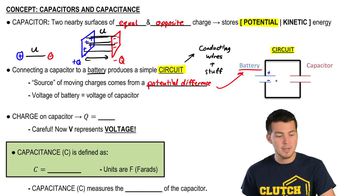
Capacitance is the ability of a system to store an electric charge per unit voltage. It is measured in farads (F), where 1 farad is defined as the capacitance of a capacitor that stores one coulomb of charge at one volt. In this question, the 1.0 F capacitor indicates a significant capacity to store charge, which is crucial for the oscillator's operation.
Recommended video:
Guided course
08:02
Capacitors & Capacitance (Intro)

Inductance

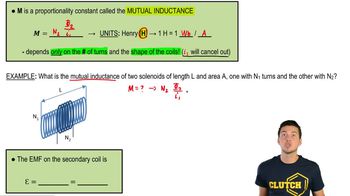
Inductance is the property of an electrical conductor that opposes a change in current. It is measured in henries (H) and is essential for the functioning of inductors in circuits. In this scenario, the inductor's design, including its length and the number of turns, will determine its inductance, which, along with the capacitance, will set the frequency of the oscillator.
Recommended video:
Guided course
12:59
Mutual Induction

Oscillator Frequency

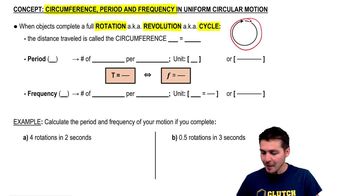
The frequency of an oscillator is determined by the values of the inductor and capacitor in the circuit, following the formula f = 1/(2π√(LC)), where f is the frequency, L is the inductance, and C is the capacitance. For a 1.0 Hz oscillator, the relationship between the inductor and capacitor values must be carefully calculated to achieve the desired frequency, making it essential to understand how these components interact.
Recommended video:
Guided course
05:08
Circumference, Period, and Frequency in UCM
Related Practice
Textbook Question

CALC Let's look at the details of eddy-current braking. A square loop, length l on each side, is shot with velocity v0 into a uniform magnetic field B. The field is perpendicular to the plane of the loop. The loop has mass m and resistance R, and it enters the field at t = 0 s. Assume that the loop is moving to the right along the x-axis and that the field begins at x = 0 m. Find an expression for the loop's velocity as a function of time as it enters the magnetic field. You can ignore gravity, and you can assume that the back edge of the loop has not entered the field.

Textbook Question

The switch in FIGURE P30.76 has been open for a long time. It is closed at t = 0 s. What is the current through the 20 Ω resistor after the switch has been closed a long time?

Textbook Question

CALC The rectangular loop in FIGURE CP30.81 has 0.020 Ω resistance. What is the induced current in the loop at this instant?

1
views
Textbook Question

The switch in FIGURE P30.77 has been open for a long time. It is closed at t = 0 s. After the switch has been closed for a long time, what is the current in the circuit? Call this current I0.

1
views
Textbook Question

CALC Let's look at the details of eddy-current braking. A square loop, length l on each side, is shot with velocity v0 into a uniform magnetic field B. The field is perpendicular to the plane of the loop. The loop has mass m and resistance R, and it enters the field at t=0 s. Assume that the loop is moving to the right along the x-axis and that the field begins at x = 0 m. Calculate and draw a graph of v over the interval 0 s ≤ t ≤ 0.04 s for the case that v0=10 m/s, l = 10 cm, m = 1.0 g, R = 0.0010 Ω, and B=0.10 T. The back edge of the loop does not reach the field during this time interval.

1
views
Textbook Question

The switch in FIGURE P30.77 has been open for a long time. It is closed at t = 0 s. Find an expression for the current I as a function of time. Write your expression in terms of I0, R, and L.

2
views