
Ch 30: Electromagnetic Induction
Knight Calc - Physics for Scientists and Engineers 5th Edition
Knight Calc5th EditionPhysics for Scientists and EngineersISBN: 9780137344796Not the one you use?Change textbook
Chapter 30, Problem 83b

CALC Let's look at the details of eddy-current braking. A square loop, length l on each side, is shot with velocity v0 into a uniform magnetic field B. The field is perpendicular to the plane of the loop. The loop has mass m and resistance R, and it enters the field at t=0 s. Assume that the loop is moving to the right along the x-axis and that the field begins at x = 0 m. Calculate and draw a graph of v over the interval 0 s ≤ t ≤ 0.04 s for the case that v0=10 m/s, l = 10 cm, m = 1.0 g, R = 0.0010 Ω, and B=0.10 T. The back edge of the loop does not reach the field during this time interval.

Verified step by step guidance
1
Step 1: Understand the problem setup. A square loop is moving into a uniform magnetic field with velocity v₀. As it enters the field, an induced current is generated due to the changing magnetic flux through the loop. This current creates a magnetic force (eddy current braking) that opposes the motion of the loop. The goal is to calculate the velocity v(t) over the given time interval.
Step 2: Use Faraday's Law of Induction to calculate the induced EMF (ε). The magnetic flux (Φ) through the loop is given by Φ = B × A, where A is the area of the loop inside the field. Since the loop is moving with velocity v(t), the area inside the field at any time t is A = l × x, where x = v(t) × t. Thus, Φ = B × l × v(t) × t. The induced EMF is then ε = -dΦ/dt. Differentiate Φ with respect to time to find ε.
Step 3: Relate the induced EMF to the current in the loop using Ohm's Law. The current I in the loop is given by I = ε / R, where R is the resistance of the loop. Substitute the expression for ε from Step 2 into this equation to find I as a function of v(t) and t.
Step 4: Calculate the magnetic force acting on the loop. The force F is given by F = I × l × B, where l is the length of the side of the square loop and B is the magnetic field strength. Substitute the expression for I from Step 3 into this equation to express F in terms of v(t) and t.
Step 5: Use Newton's Second Law to find the equation of motion for the loop. The net force acting on the loop is F = m × dv/dt, where m is the mass of the loop. Set the magnetic force from Step 4 equal to m × dv/dt and solve this differential equation to find v(t). Use the initial condition v(0) = v₀ to determine the constant of integration. Once v(t) is determined, plot the graph of v(t) over the interval 0 s ≤ t ≤ 0.04 s.

Verified video answer for a similar problem:

This video solution was recommended by our tutors as helpful for the problem above.
Was this helpful?

Key Concepts

Here are the essential concepts you must grasp in order to answer the question correctly.

Eddy Currents

Eddy currents are loops of electric current that are induced within conductors by a changing magnetic field due to Faraday's law of electromagnetic induction. When a conductive loop moves through a magnetic field, the change in magnetic flux through the loop generates these currents, which create their own magnetic fields opposing the motion of the loop. This phenomenon is the basis for eddy-current braking, where the induced currents dissipate kinetic energy as heat, slowing down the loop.
Recommended video:
Guided course
05:38
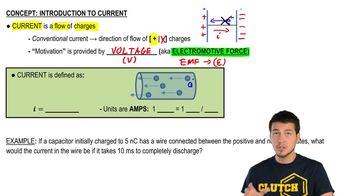
Intro to Current

Magnetic Flux

Magnetic flux refers to the total magnetic field passing through a given area and is calculated as the product of the magnetic field strength and the area perpendicular to the field. In the context of the problem, as the square loop enters the magnetic field, the magnetic flux through the loop changes, which induces eddy currents. Understanding how magnetic flux varies with time is crucial for analyzing the forces acting on the loop and its resulting motion.
Recommended video:
Guided course
04:52
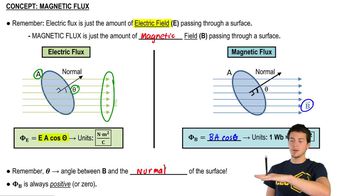
Magnetic Flux

Newton's Second Law of Motion

Newton's Second Law states that the acceleration of an object is directly proportional to the net force acting on it and inversely proportional to its mass, expressed mathematically as F = ma. In this scenario, the loop experiences a magnetic force due to the eddy currents, which acts in the opposite direction to its motion. This force will affect the loop's velocity over time, making it essential to apply this law to determine how the loop's speed changes as it interacts with the magnetic field.
Recommended video:
Guided course
06:54
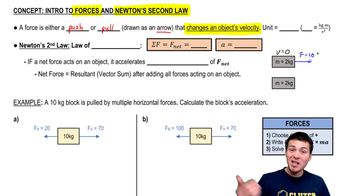
Intro to Forces & Newton's Second Law
Related Practice
Textbook Question

CALC Let's look at the details of eddy-current braking. A square loop, length l on each side, is shot with velocity v0 into a uniform magnetic field B. The field is perpendicular to the plane of the loop. The loop has mass m and resistance R, and it enters the field at t = 0 s. Assume that the loop is moving to the right along the x-axis and that the field begins at x = 0 m. Find an expression for the loop's velocity as a function of time as it enters the magnetic field. You can ignore gravity, and you can assume that the back edge of the loop has not entered the field.

Textbook Question

CALC High-frequency signals are often transmitted along a coaxial cable, such as the one shown in FIGURE CP30.86. For example, the cable TV hookup coming into your home is a coaxial cable. The signal is carried on a wire of radius r1 while the outer conductor of radius r2 is grounded. A soft, flexible insulating material fills the space between them, and an insulating plastic coating goes around the outside. Evaluate the inductance per meter of a cable having r1 = 0.50 mm and r2 = 3.0 mm.

Textbook Question

CALC The rectangular loop in FIGURE CP30.81 has 0.020 Ω resistance. What is the induced current in the loop at this instant?

1
views
Textbook Question

In recent years it has been possible to buy a 1.0 F capacitor. This is an enormously large amount of capacitance. Suppose you want to build a 1.0 Hz oscillator with a 1.0 F capacitor. You have a spool of 0.25-mm-diameter wire and a 4.0-cm-diameter plastic cylinder. How long must your inductor be if you wrap it with 2 layers of closely spaced turns?

2
views