
Ch 30: Electromagnetic Induction
Knight Calc - Physics for Scientists and Engineers 5th Edition
Knight Calc5th EditionPhysics for Scientists and EngineersISBN: 9780137344796Not the one you use?Change textbook
Chapter 30, Problem 77b

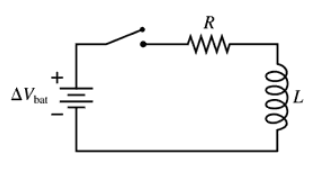
The switch in FIGURE P30.77 has been open for a long time. It is closed at t = 0 s. Find an expression for the current I as a function of time. Write your expression in terms of I0, R, and L.

Verified step by step guidance
1
Step 1: Recognize that the circuit contains a resistor (R) and an inductor (L) in series with a battery of voltage ΔV_bat. When the switch is closed at t = 0, the current I(t) will increase over time due to the inductive property of the inductor, which opposes changes in current.
Step 2: Apply Kirchhoff's Voltage Law (KVL) to the circuit. The total voltage across the circuit is equal to the sum of the voltage drops across the resistor and the inductor. This gives the equation: ΔV_bat = I(t)R + L(dI/dt), where dI/dt is the rate of change of current.
Step 3: Rearrange the equation to isolate the derivative term: L(dI/dt) = ΔV_bat - I(t)R. Divide through by L to express the rate of change of current: dI/dt = (ΔV_bat/L) - (R/L)I(t).
Step 4: Recognize that this is a first-order linear differential equation. Solve it using the standard method for such equations. The solution involves finding the homogeneous solution and the particular solution. The general solution for current I(t) is: I(t) = I0(1 - e^(-Rt/L)), where I0 = ΔV_bat/R is the steady-state current.
Step 5: Interpret the result. The expression I(t) = I0(1 - e^(-Rt/L)) shows that the current starts at 0 when t = 0 and asymptotically approaches I0 as t → ∞. The time constant τ = L/R determines how quickly the current reaches its steady-state value.

Verified video answer for a similar problem:

This video solution was recommended by our tutors as helpful for the problem above.
Was this helpful?

Key Concepts

Here are the essential concepts you must grasp in order to answer the question correctly.

Inductance (L)

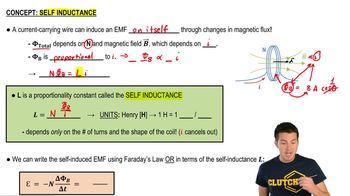
Inductance is a property of an electrical component, typically a coil or inductor, that quantifies its ability to store energy in a magnetic field when an electric current flows through it. The unit of inductance is the henry (H). In circuits, inductance affects how quickly the current can change, leading to a time-dependent behavior when the circuit is switched on or off.
Recommended video:
Guided course
07:58
Self Inductance

Resistance (R)

Resistance is a measure of the opposition to the flow of electric current in a circuit. It is quantified in ohms (Ω) and is determined by the material, length, and cross-sectional area of the conductor. In the context of the circuit, resistance affects how much current flows when a voltage is applied, influencing the time it takes for the current to reach its maximum value after the switch is closed.
Recommended video:
Guided course
05:25
Resistivity & Resistors in Circuits

Current (I) as a function of time

Current as a function of time describes how the electric current changes over time in response to circuit conditions. In an RL circuit, when the switch is closed, the current does not instantly reach its maximum value but instead increases gradually, following an exponential growth pattern. The expression for current can be derived using Kirchhoff's laws and the differential equations governing RL circuits, typically resulting in a formula involving the initial current (I0), resistance (R), and inductance (L).
Recommended video:
Guided course
08:30
Intro to Wave Functions
Related Practice
Textbook Question

CALC Let's look at the details of eddy-current braking. A square loop, length l on each side, is shot with velocity v0 into a uniform magnetic field B. The field is perpendicular to the plane of the loop. The loop has mass m and resistance R, and it enters the field at t = 0 s. Assume that the loop is moving to the right along the x-axis and that the field begins at x = 0 m. Find an expression for the loop's velocity as a function of time as it enters the magnetic field. You can ignore gravity, and you can assume that the back edge of the loop has not entered the field.

Textbook Question

The switch in FIGURE P30.76 has been open for a long time. It is closed at t = 0 s. What is the current through the 20 Ω resistor after the switch has been closed a long time?

Textbook Question

CALC The rectangular loop in FIGURE CP30.81 has 0.020 Ω resistance. What is the induced current in the loop at this instant?

1
views
Textbook Question

The switch in FIGURE P30.76 has been open for a long time. It is closed at t = 0 s. What is the current through the 20 Ω resistor immediately after the switch is closed?

Textbook Question

The switch in FIGURE P30.77 has been open for a long time. It is closed at t = 0 s. After the switch has been closed for a long time, what is the current in the circuit? Call this current I0.

1
views
Textbook Question

In recent years it has been possible to buy a 1.0 F capacitor. This is an enormously large amount of capacitance. Suppose you want to build a 1.0 Hz oscillator with a 1.0 F capacitor. You have a spool of 0.25-mm-diameter wire and a 4.0-cm-diameter plastic cylinder. How long must your inductor be if you wrap it with 2 layers of closely spaced turns?

2
views