Ch 30: Electromagnetic Induction
Knight Calc - Physics for Scientists and Engineers 5th Edition
Knight Calc5th EditionPhysics for Scientists and EngineersISBN: 9780137344796Not the one you use?Change textbook
Chapter 30, Problem 72

An electric oscillator is made with a 0.10 μF capacitor and a 1.0 mH inductor. The capacitor is initially charged to 5.0 V. What is the maximum current through the inductor as the circuit oscillates?

Verified step by step guidance
1
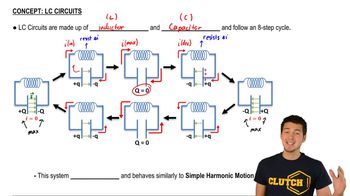
Step 1: Recognize that the system described is an LC circuit, which oscillates energy between the capacitor and the inductor. The total energy in the system remains constant and is given by the formula for the energy stored in a capacitor: Etotal = 12CV2, where C is the capacitance and V is the initial voltage across the capacitor.
Step 2: Write the expression for the maximum current in the inductor. At the point of maximum current, all the energy in the circuit is stored in the inductor as magnetic energy. The energy stored in the inductor is given by: Einductor = 12LI2, where L is the inductance and I is the maximum current.
Step 3: Equate the total energy in the capacitor to the energy in the inductor at maximum current, since energy is conserved in the LC circuit. This gives: 12CV2 = 12LI2.
Step 4: Solve for the maximum current I. Rearrange the equation to isolate I: I = CLV. Substitute the given values for C = 0.10 \, \(\text{μF}\) = 0.10 \, imes \, 10^{-6} \, \(\text{F}\), L = 1.0 \, \(\text{mH}\) = 1.0 \, imes \, 10^{-3} \, \(\text{H}\), and V = 5.0 \, \(\text{V}\).
Step 5: Perform the substitution and simplify the expression for I. This will yield the maximum current through the inductor. Ensure that the units are consistent when performing the calculation.

Verified video answer for a similar problem:

This video solution was recommended by our tutors as helpful for the problem above.
Video duration:
8m
Was this helpful?

Key Concepts

Here are the essential concepts you must grasp in order to answer the question correctly.

Capacitance

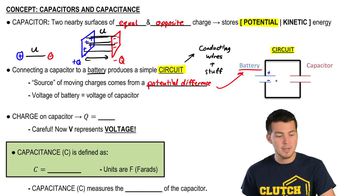
Capacitance is the ability of a capacitor to store charge per unit voltage, measured in farads (F). In this case, the 0.10 μF capacitor can store a certain amount of electrical energy when charged to a voltage of 5.0 V. The stored energy can be released into the circuit, influencing the oscillation of the electric oscillator.
Recommended video:
Guided course
08:02
Capacitors & Capacitance (Intro)

Inductance

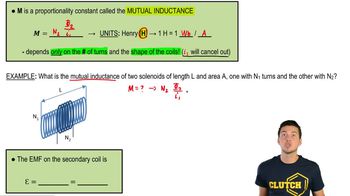
Inductance is a property of an inductor that quantifies its ability to store energy in a magnetic field when an electric current flows through it, measured in henries (H). The 1.0 mH inductor in the circuit will oppose changes in current, contributing to the oscillatory behavior of the circuit as energy transfers between the capacitor and the inductor.
Recommended video:
Guided course
12:59
Mutual Induction

Resonance in LC Circuits

Resonance in LC circuits occurs when the inductive and capacitive reactances are equal, allowing for maximum energy transfer and oscillation. The maximum current through the inductor can be calculated using the formula derived from the energy stored in the capacitor, which is converted to magnetic energy in the inductor during oscillation, leading to a peak current at resonance.
Recommended video: