Ch 30: Electromagnetic Induction
Knight Calc - Physics for Scientists and Engineers 5th Edition
Knight Calc5th EditionPhysics for Scientists and EngineersISBN: 9780137344796Not the one you use?Change textbook
Chapter 30, Problem 70b

CALC The current through inductance L is given by I=I0et/τI = I_0 e^{-t/\(\tau\)}. Evaluate ΔVL at t = 0, 1.0, and 3.0 ms if L = 20 mH, I0 = 50 mA, and τ\(\tau\) = 1.0 ms.

Verified step by step guidance
1
Step 1: Recall the formula for the voltage across an inductor, which is given by ΔV_L = L * (dI/dt), where L is the inductance and dI/dt is the time derivative of the current I.
Step 2: Write the given current equation I(t) = I_0 * e^(-t/τ). Differentiate this equation with respect to time t to find dI/dt. The derivative is dI/dt = -I_0/τ * e^(-t/τ).
Step 3: Substitute the given values into the expression for dI/dt. Use I_0 = 50 mA (0.050 A), τ = 1.0 ms (0.001 s), and L = 20 mH (0.020 H). The expression becomes ΔV_L = L * (-I_0/τ * e^(-t/τ)).
Step 4: Evaluate ΔV_L at the specified times t = 0, 1.0 ms, and 3.0 ms. For each time, substitute t into the expression ΔV_L = 0.020 * (-0.050/0.001) * e^(-t/0.001). Simplify the exponential term e^(-t/0.001) for each time value.
Step 5: After substituting and simplifying for each time value, you will have the voltage across the inductor ΔV_L at t = 0, 1.0 ms, and 3.0 ms. Ensure the units are consistent throughout the calculation (e.g., volts for ΔV_L).

Verified video answer for a similar problem:

This video solution was recommended by our tutors as helpful for the problem above.
Was this helpful?

Key Concepts

Here are the essential concepts you must grasp in order to answer the question correctly.

Inductance

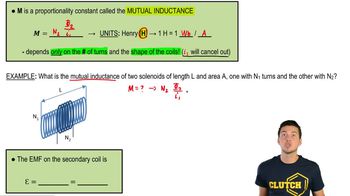
Inductance is a property of an electrical component, typically a coil or inductor, that quantifies its ability to store energy in a magnetic field when an electric current flows through it. The unit of inductance is the henry (H). In circuits, inductance affects how quickly current can change, influencing the behavior of the circuit during transient states.
Recommended video:
Guided course
12:59
Mutual Induction

Time Constant (τ)

The time constant, denoted as τ (tau), is a measure of the time it takes for the current in an inductor to reach approximately 63.2% of its maximum value after a change in voltage. It is calculated as τ = L/R, where L is inductance and R is resistance. In this context, τ helps determine how quickly the current decays over time.
Recommended video:
Guided course
08:59
Phase Constant of a Wave Function

Voltage Across an Inductor (ΔVL)

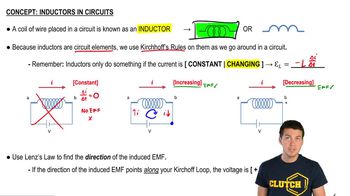
The voltage across an inductor (ΔVL) is related to the rate of change of current through it. According to Faraday's law of electromagnetic induction, this voltage can be expressed as ΔVL = L * (dI/dt), where dI/dt is the rate of change of current with respect to time. Understanding this relationship is crucial for evaluating the voltage at specific time intervals in the given problem.
Recommended video:
Guided course
07:10
Inductors in Circuits