Ch. 2 - Functions and Graphs
Blitzer - College Algebra 8th Edition
Blitzer8th EditionCollege AlgebraISBN: 9780136970514Not the one you use?Change textbook
Chapter 3, Problem 62

In Exercises 60–63, begin by graphing the standard quadratic function, f(x) = x2. Then use transformations of this graph to graph the given function. r(x) = -(x + 1)2

Verified step by step guidance
1
Start by recalling the graph of the standard quadratic function \(f(x) = x^2\). This is a parabola opening upwards with its vertex at the origin \((0,0)\).
Identify the given function \(r(x) = -(x + 1)^2\). Notice that it is a transformation of \(f(x) = x^2\).
Recognize the transformations: the expression \((x + 1)\) inside the squared term indicates a horizontal shift. Specifically, \(x + 1\) means the graph shifts 1 unit to the left.
The negative sign in front of the squared term, \(- (x + 1)^2\), reflects the graph over the x-axis, changing the parabola to open downwards instead of upwards.
Combine these transformations: start with the graph of \(f(x) = x^2\), shift it 1 unit left, then reflect it over the x-axis to get the graph of \(r(x) = -(x + 1)^2\).

Verified video answer for a similar problem:

This video solution was recommended by our tutors as helpful for the problem above.
Video duration:
1m
Was this helpful?

Key Concepts

Here are the essential concepts you must grasp in order to answer the question correctly.

Standard Quadratic Function

The standard quadratic function is f(x) = x², which graphs as a parabola opening upwards with its vertex at the origin (0,0). It serves as the base graph for understanding transformations applied to quadratic functions.
Recommended video:
04:34
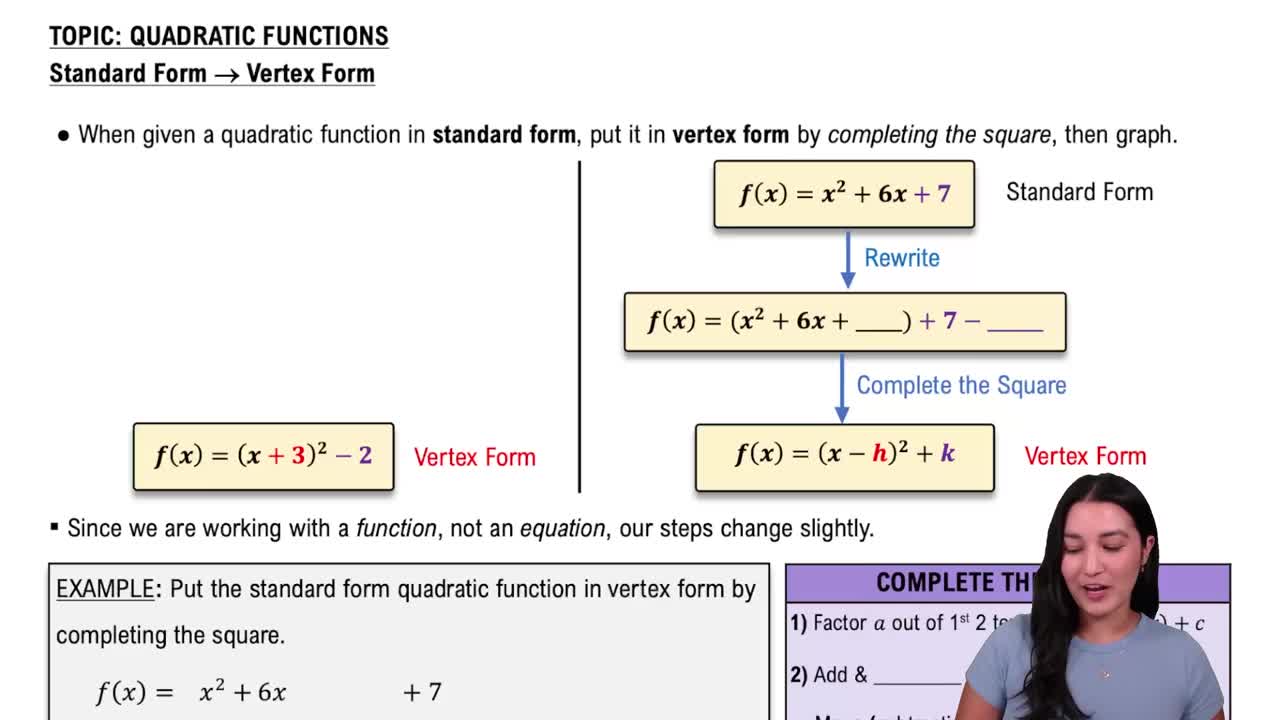
Converting Standard Form to Vertex Form

Graph Transformations

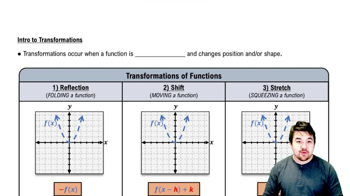
Graph transformations involve shifting, reflecting, stretching, or compressing the base graph. For example, adding or subtracting inside the function shifts the graph horizontally, while multiplying by a negative reflects it across the x-axis.
Recommended video:
5:25
Intro to Transformations

Reflection Across the x-axis

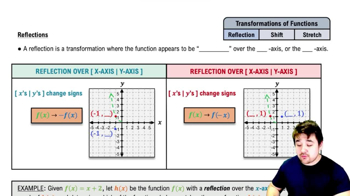
Multiplying a function by -1 reflects its graph across the x-axis, flipping it upside down. For r(x) = -(x + 1)², this means the parabola opens downward instead of upward.
Recommended video:
5:00
Reflections of Functions