Ch. 2 - Functions and Graphs
Blitzer - College Algebra 8th Edition
Blitzer8th EditionCollege AlgebraISBN: 9780136970514Not the one you use?Change textbook
Chapter 3, Problem 62a

Begin by graphing the standard quadratic function, f(x) = x². Then use transformations of this graph to graph the given function. g(x) = (1/2)(x − 1)²

Verified step by step guidance
1
Start with the standard quadratic function f(x) = x². This is a parabola that opens upwards with its vertex at the origin (0, 0). The graph is symmetric about the y-axis.
Identify the transformations applied to f(x) = x² to obtain g(x) = (1/2)(x − 1)². The transformations include: (1) a horizontal shift, (2) a vertical stretch/compression, and (3) a vertical scaling factor.
First, note the horizontal shift. The term (x − 1)² indicates a shift of the graph 1 unit to the right. This is because the subtraction inside the parentheses moves the graph in the opposite direction of the sign.
Next, observe the vertical scaling factor. The coefficient (1/2) outside the squared term compresses the graph vertically by a factor of 1/2. This makes the parabola wider compared to the standard f(x) = x².
Combine these transformations to graph g(x). Start by shifting the vertex of f(x) = x² from (0, 0) to (1, 0). Then, apply the vertical compression by scaling the y-values of the graph by 1/2. The resulting graph is a wider parabola with its vertex at (1, 0).

Verified video answer for a similar problem:

This video solution was recommended by our tutors as helpful for the problem above.
Video duration:
1m
Was this helpful?

Key Concepts

Here are the essential concepts you must grasp in order to answer the question correctly.

Quadratic Functions

A quadratic function is a polynomial function of degree two, typically expressed in the form f(x) = ax² + bx + c. The graph of a quadratic function is a parabola, which opens upwards if 'a' is positive and downwards if 'a' is negative. Understanding the basic shape and properties of the standard quadratic function, f(x) = x², is essential for applying transformations to graph other quadratic functions.
Recommended video:
06:36
Solving Quadratic Equations Using The Quadratic Formula

Transformations of Functions

Transformations of functions involve shifting, stretching, compressing, or reflecting the graph of a function. For quadratic functions, common transformations include vertical and horizontal shifts, which can be represented by modifying the function's equation. For example, in g(x) = (1/2)(x - 1)², the graph is shifted right by 1 unit and vertically compressed by a factor of 1/2, altering its appearance while maintaining its parabolic shape.
Recommended video:
4:22
Domain & Range of Transformed Functions

Vertex Form of Quadratic Functions

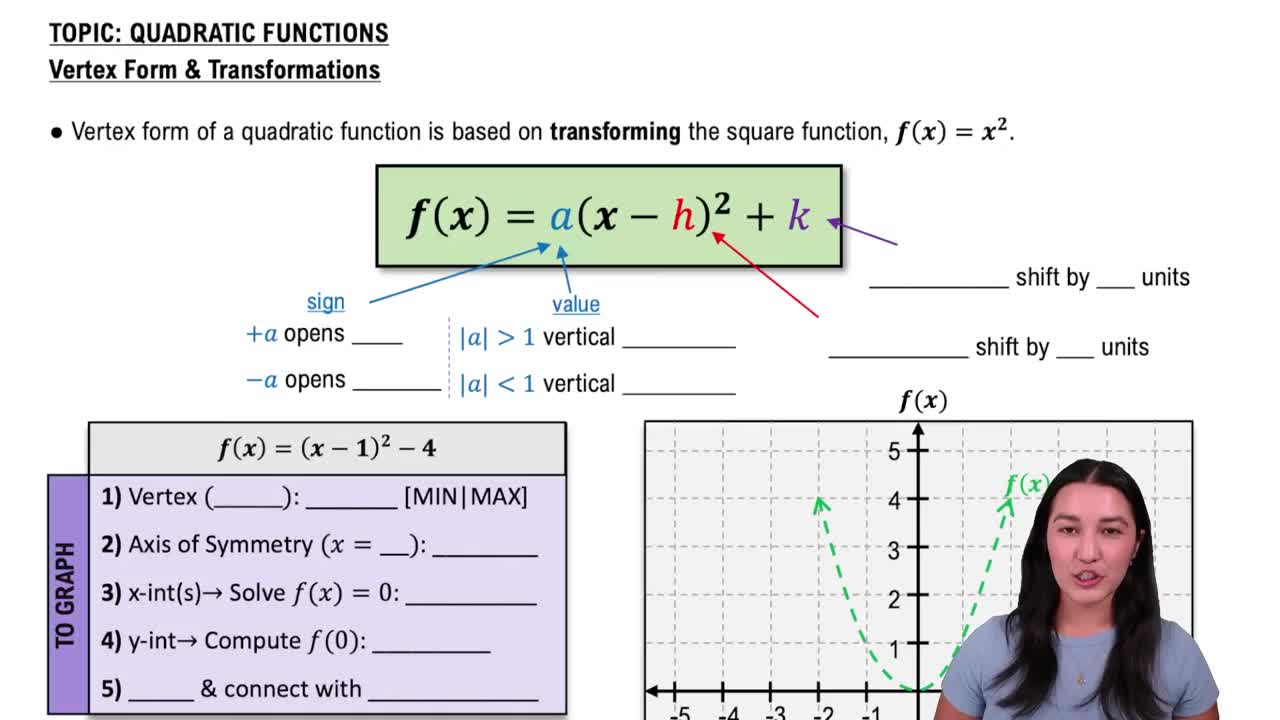
The vertex form of a quadratic function is given by f(x) = a(x - h)² + k, where (h, k) is the vertex of the parabola. This form makes it easier to identify the vertex and understand how transformations affect the graph. In the function g(x) = (1/2)(x - 1)², the vertex is at (1, 0), indicating the point where the parabola reaches its minimum value, which is crucial for accurately graphing the function.
Recommended video:
08:07
Vertex Form