In Exercises 59-64, let f(x) = 2x - 5 g(x) = 4x - 1 h(x) = x² + x + 2. Evaluate the indicated function without finding an equation for the function. g (f[h (1)])
Ch. 2 - Functions and Graphs

Chapter 3, Problem 63
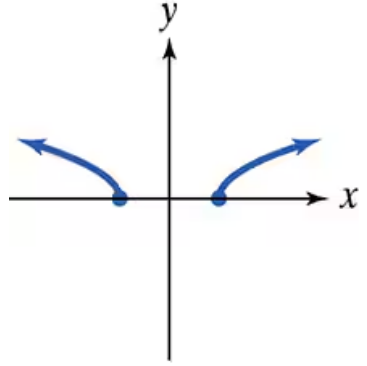
Use the vertical line test to identify graphs in which y is a function of x.

Verified step by step guidance1
Recall the vertical line test: A graph represents y as a function of x if and only if no vertical line intersects the graph at more than one point.
Examine the blue curve on the left side of the graph. Imagine drawing vertical lines at various x-values along this curve and observe if any vertical line crosses the curve more than once.
Do the same for the orange curve on the right side of the graph, checking if any vertical line intersects it at more than one point.
If for a given curve, every vertical line intersects it at most once, then y is a function of x for that curve.
Based on your observations, conclude which of the two curves (blue or orange) represents y as a function of x.

Verified video answer for a similar problem:
This video solution was recommended by our tutors as helpful for the problem above.
Video duration:
58sWas this helpful?
Key Concepts
Here are the essential concepts you must grasp in order to answer the question correctly.
Vertical Line Test
The vertical line test is a visual method used to determine if a graph represents a function. If any vertical line drawn through the graph intersects it at more than one point, the graph does not represent a function. This test ensures that each input (x-value) corresponds to exactly one output (y-value).
Recommended video:
Guided course
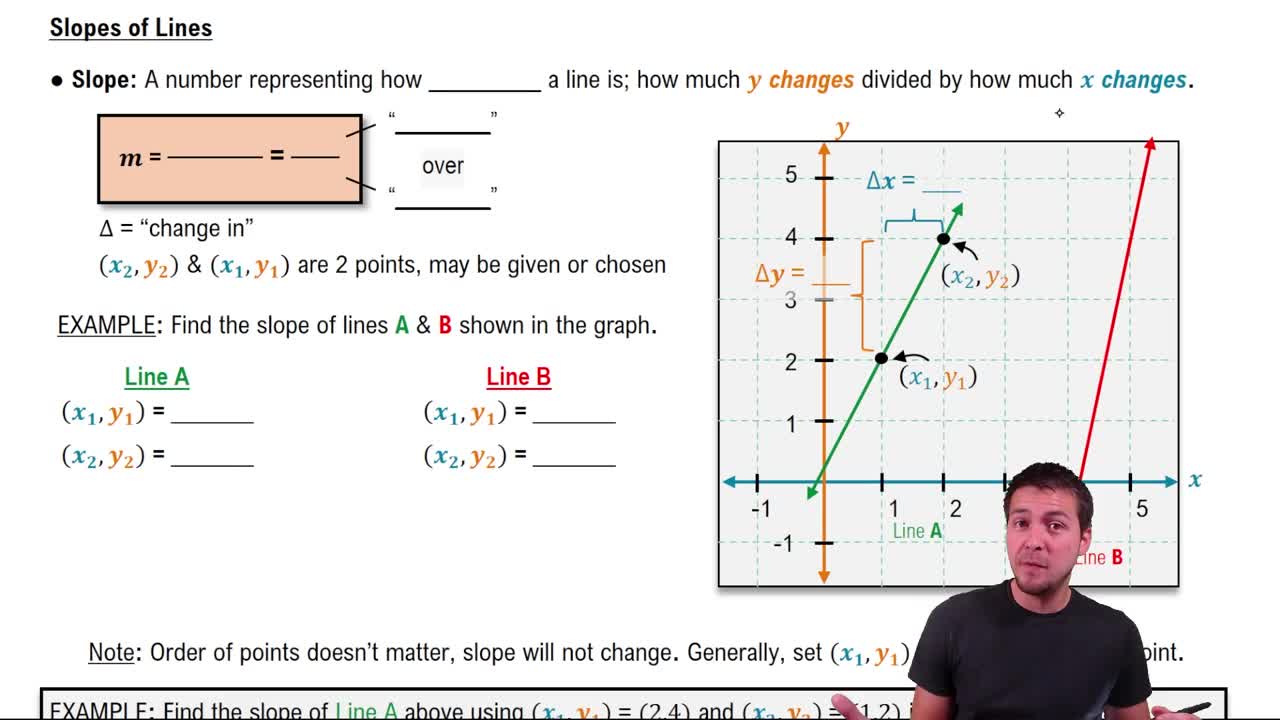
The Slope of a Line
Definition of a Function
A function is a relation where each input value (x) has exactly one output value (y). This means no x-value can be paired with multiple y-values. Understanding this definition is crucial to applying the vertical line test and interpreting graphs correctly.
Recommended video:
Graphs of Common Functions
Graph Interpretation and Coordinate Plane
Interpreting graphs involves understanding the coordinate plane, where the horizontal axis represents x-values and the vertical axis represents y-values. Recognizing how curves behave and their position relative to the axes helps in applying tests like the vertical line test to determine function status.
Recommended video:
Guided course
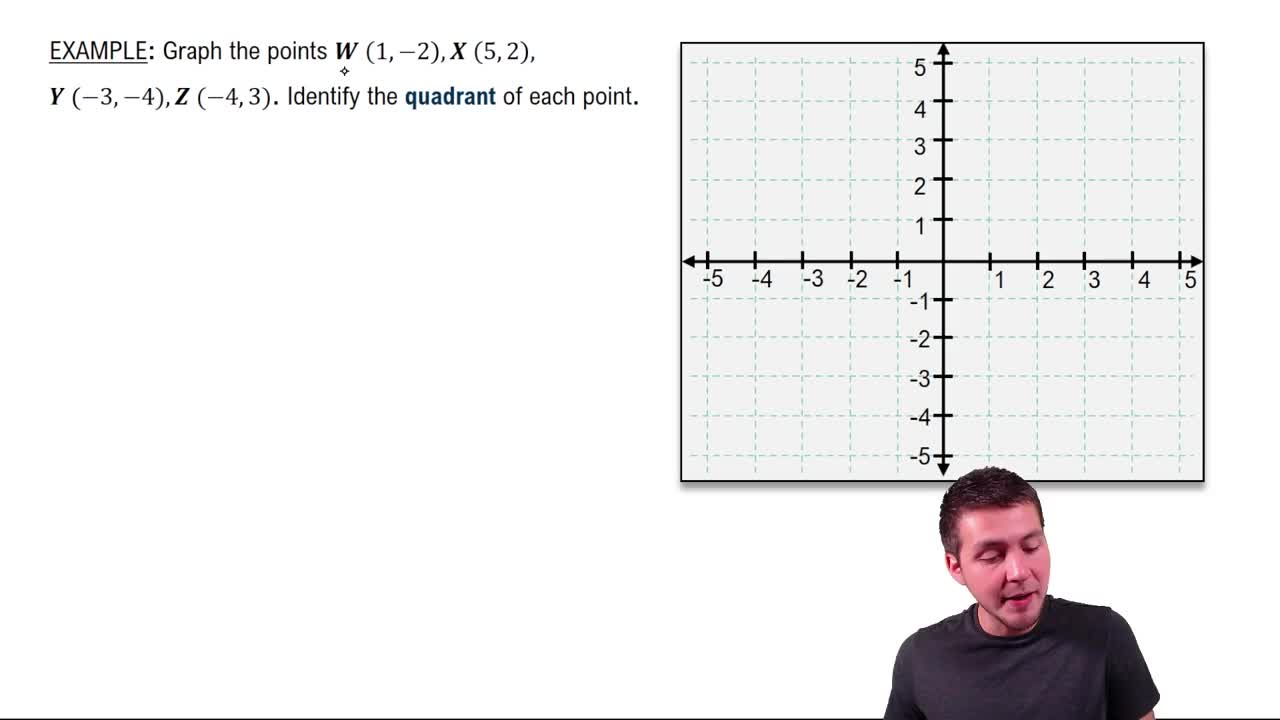
Graphs and Coordinates - Example
Related Practice
Textbook Question
Textbook Question
In Exercises 59-66, a. Rewrite the given equation in slope-intercept form. b. Give the slope and y-intercept. c. Use the slope and y-intercept to graph the linear function. 8x – 4y – 12 =0
Textbook Question
Use the vertical line test to identify graphs in which y is a function of x.
1
views
Textbook Question
In Exercises 60–63, begin by graphing the standard quadratic function, f(x) = x2. Then use transformations of this graph to graph the given function. r(x) = -(x + 1)2
4
views
Textbook Question
Find a. (fog) (x) b. (go f) (x) c. (fog) (2) d. (go f) (2).
f(x) = 2x-3, g(x) = (x+3)/2
Textbook Question
Begin by graphing the standard quadratic function, f(x) = x². Then use transformations of this graph to graph the given function. g(x) = (1/2)(x − 1)²
1
views