Complete the square and write the equation in standard form. Then give the center and radius of each circle and graph the equation. x² + y²+3x+5y+9/4=0
Ch. 2 - Functions and Graphs

Chapter 3, Problem 63a
Find a. (fog) (x) b. (go f) (x) c. (fog) (2) d. (go f) (2).
f(x) = 2x-3, g(x) = (x+3)/2
Verified step by step guidance1
Step 1: Understand the problem. You are tasked with finding the compositions of two functions, f(x) = 2x - 3 and g(x) = (x + 3)/2, in four parts: (fog)(x), (gof)(x), (fog)(2), and (gof)(2). Composition of functions means substituting one function into another.
Step 2: To find (fog)(x), substitute g(x) into f(x). Replace every instance of 'x' in f(x) = 2x - 3 with g(x) = (x + 3)/2. This gives f(g(x)) = 2((x + 3)/2) - 3. Simplify the expression.
Step 3: To find (gof)(x), substitute f(x) into g(x). Replace every instance of 'x' in g(x) = (x + 3)/2 with f(x) = 2x - 3. This gives g(f(x)) = ((2x - 3) + 3)/2. Simplify the expression.
Step 4: To find (fog)(2), use the result from Step 2 and substitute x = 2 into the simplified expression for (fog)(x). Simplify the result.
Step 5: To find (gof)(2), use the result from Step 3 and substitute x = 2 into the simplified expression for (gof)(x). Simplify the result.

Verified video answer for a similar problem:
This video solution was recommended by our tutors as helpful for the problem above.
Video duration:
1mWas this helpful?
Key Concepts
Here are the essential concepts you must grasp in order to answer the question correctly.
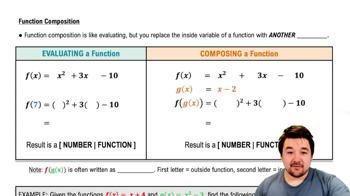
Function Composition
Function composition involves combining two functions to create a new function. If f(x) and g(x) are two functions, the composition (fog)(x) means applying g first and then f to the result, expressed as f(g(x)). This concept is essential for solving the given exercises, as it requires evaluating the output of one function as the input for another.
Recommended video:
Function Composition
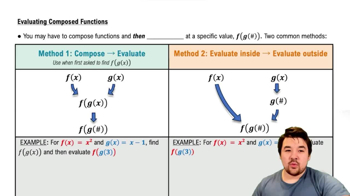
Evaluating Functions
Evaluating functions means substituting a specific value into a function to find its output. For example, if f(x) = 2x - 3, to evaluate f(2), you replace x with 2, resulting in f(2) = 2(2) - 3 = 1. This skill is crucial for calculating the values of (fog)(2) and (go f)(2) in the exercises.
Recommended video:
Evaluating Composed Functions
Algebraic Manipulation
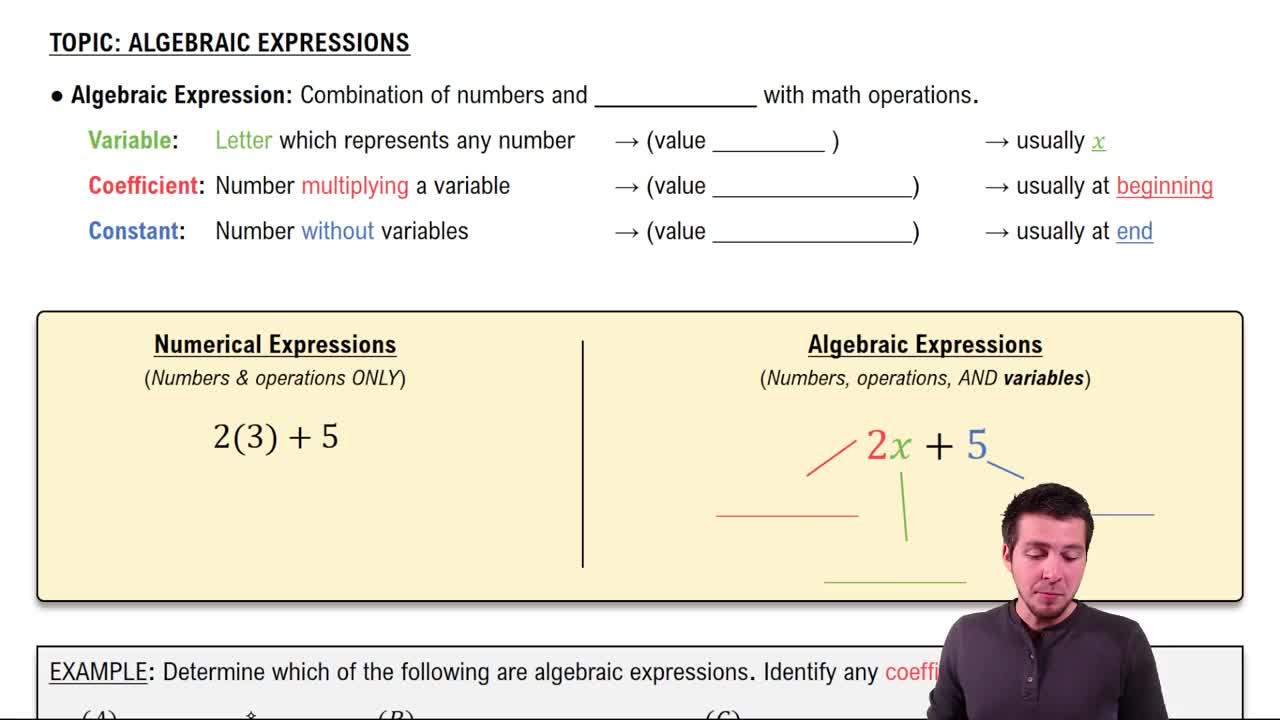
Algebraic manipulation refers to the process of rearranging and simplifying expressions using algebraic rules. This includes operations like addition, subtraction, multiplication, and division of functions. Mastery of these techniques is necessary to simplify the results of function compositions and to ensure accurate evaluations in the exercises.
Recommended video:
Guided course
Introduction to Algebraic Expressions
Related Practice
Textbook Question
1
views
Textbook Question
In Exercises 59-64, let f(x) = 2x - 5 g(x) = 4x - 1 h(x) = x² + x + 2. Evaluate the indicated function without finding an equation for the function. g (f[h (1)])
Textbook Question
In Exercises 59-66, a. Rewrite the given equation in slope-intercept form. b. Give the slope and y-intercept. c. Use the slope and y-intercept to graph the linear function. 8x – 4y – 12 =0
Textbook Question
Let f(x) = 2x - 5 g(x) = 4x - 1 h(x) = x² + x + 2. Evaluate the indicated function without finding an equation for the function. f(g[h (1)])
3
views
Textbook Question
In Exercises 64–66, begin by graphing the square root function, f(x) = √x. Then use transformations of this graph to graph the given function. g(x) = √(x + 3)
Textbook Question
Use the vertical line test to identify graphs in which y is a function of x.