Complete the square and write the equation in standard form. Then give the center and radius of each circle and graph the equation. x² + y²+3x+5y+9/4=0
Ch. 2 - Functions and Graphs

Chapter 3, Problem 64
Let f(x) = 2x - 5 g(x) = 4x - 1 h(x) = x² + x + 2. Evaluate the indicated function without finding an equation for the function. f(g[h (1)])
Verified step by step guidance1
First, identify the innermost function to evaluate, which is \( h(1) \). Substitute \( x = 1 \) into \( h(x) = x^2 + x + 2 \) to find \( h(1) \).
Next, take the result from \( h(1) \) and substitute it into \( g(x) = 4x - 1 \) to find \( g(h(1)) \).
Then, take the result from \( g(h(1)) \) and substitute it into \( f(x) = 2x - 5 \) to find \( f(g(h(1))) \).
Remember to perform each substitution step carefully, simplifying the expressions at each stage before moving to the next function.
By following these steps, you will evaluate \( f(g(h(1))) \) without needing to find the composite function's explicit formula.

Verified video answer for a similar problem:
This video solution was recommended by our tutors as helpful for the problem above.
Video duration:
3mWas this helpful?
Key Concepts
Here are the essential concepts you must grasp in order to answer the question correctly.
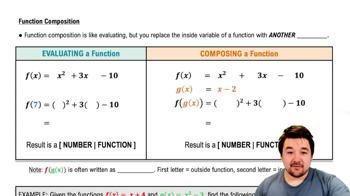
Function Composition
Function composition involves applying one function to the result of another, denoted as (f ∘ g)(x) = f(g(x)). In this problem, you evaluate functions inside out, starting with the innermost function h(1), then applying g to that result, and finally f to the output of g.
Recommended video:
Function Composition
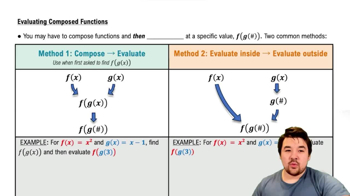
Evaluating Functions at a Given Input
Evaluating a function means substituting a specific value for the variable and simplifying. For example, to find h(1), replace x with 1 in h(x) = x² + x + 2 and calculate the result. This step-by-step substitution is essential for nested function evaluation.
Recommended video:
Evaluating Composed Functions
Order of Operations in Nested Functions
When dealing with nested functions like f(g(h(1))), you must follow the order from the innermost function outward. First evaluate h(1), then use that result as input for g, and finally apply f to the output of g. This ensures accurate and systematic calculation.
Recommended video:
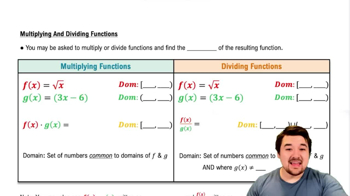
Multiplying & Dividing Functions
Related Practice
Textbook Question
1
views
Textbook Question
In Exercises 59-64, let f(x) = 2x - 5 g(x) = 4x - 1 h(x) = x² + x + 2. Evaluate the indicated function without finding an equation for the function. g (f[h (1)])
Textbook Question
In Exercises 59-66, a. Rewrite the given equation in slope-intercept form. b. Give the slope and y-intercept. c. Use the slope and y-intercept to graph the linear function. 8x – 4y – 12 =0
Textbook Question
Begin by graphing the standard quadratic function, f(x) = x². Then use transformations of this graph to graph the given function. h(x) = (1/2) (x − 1)² – 1
Textbook Question
In Exercises 64–66, begin by graphing the square root function, f(x) = √x. Then use transformations of this graph to graph the given function. g(x) = √(x + 3)
Textbook Question
Find a. (fog) (x) b. (go f) (x) c. (fog) (2) d. (go f) (2).
f(x) = 2x-3, g(x) = (x+3)/2