Complete the square and write the equation in standard form. Then give the center and radius of each circle and graph the equation. x² + y²+3x+5y+9/4=0
Ch. 2 - Functions and Graphs

Chapter 3, Problem 64
In Exercises 64–66, begin by graphing the square root function, f(x) = √x. Then use transformations of this graph to graph the given function. g(x) = √(x + 3)
Verified step by step guidance1
Start by understanding the parent function: \(f(x) = \sqrt{x}\). This function is defined for \(x \geq 0\) and its graph starts at the origin \((0,0)\), increasing slowly to the right.
Identify the transformation in the given function \(g(x) = \sqrt{x + 3}\). Notice that inside the square root, \(x\) is replaced by \(x + 3\), which indicates a horizontal shift.
Recall that replacing \(x\) by \(x + c\) inside the function shifts the graph horizontally to the left by \(c\) units. Here, \(c = 3\), so the graph of \(f(x)\) shifts 3 units to the left.
To graph \(g(x)\), take the graph of \(f(x) = \sqrt{x}\) and move every point 3 units left. For example, the starting point of \(f(x)\) at \((0,0)\) moves to \((-3,0)\) for \(g(x)\).
Finally, sketch the transformed graph starting at \((-3,0)\) and increasing to the right, maintaining the same shape as the original square root function.

Verified video answer for a similar problem:
This video solution was recommended by our tutors as helpful for the problem above.
Video duration:
1mWas this helpful?
Key Concepts
Here are the essential concepts you must grasp in order to answer the question correctly.
Square Root Function
The square root function, f(x) = √x, outputs the non-negative root of x and is defined for x ≥ 0. Its graph starts at the origin (0,0) and increases slowly, forming a curve in the first quadrant. Understanding this base graph is essential before applying transformations.
Recommended video:
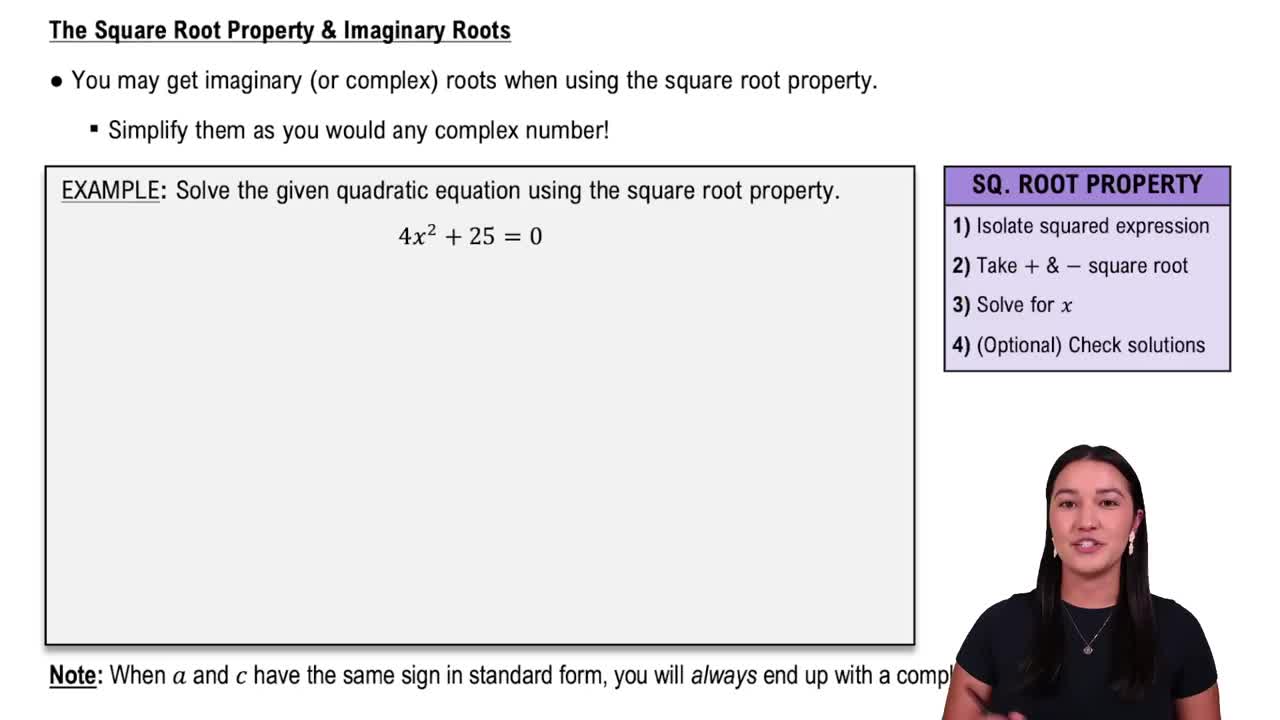
Imaginary Roots with the Square Root Property
Function Transformations
Function transformations involve shifting, stretching, compressing, or reflecting the graph of a base function. For g(x) = √(x + 3), the '+3' inside the square root causes a horizontal shift of the graph to the left by 3 units. Recognizing how changes inside the function affect the graph is key.
Recommended video:
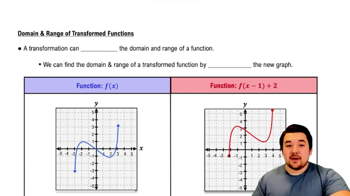
Domain & Range of Transformed Functions
Horizontal Shifts
A horizontal shift moves the graph left or right along the x-axis. For a function f(x + c), the graph shifts left by c units if c > 0, and right if c < 0. In g(x) = √(x + 3), the '+3' shifts the graph of √x three units left, changing the domain accordingly.
Recommended video:
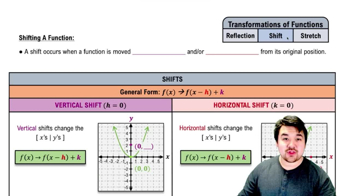
Shifts of Functions
Related Practice
Textbook Question
1
views
Textbook Question
In Exercises 59-64, let f(x) = 2x - 5 g(x) = 4x - 1 h(x) = x² + x + 2. Evaluate the indicated function without finding an equation for the function. g (f[h (1)])
Textbook Question
Begin by graphing the standard quadratic function, f(x) = x². Then use transformations of this graph to graph the given function. h(x) = (1/2) (x − 1)² – 1
Textbook Question
Let f(x) = 2x - 5 g(x) = 4x - 1 h(x) = x² + x + 2. Evaluate the indicated function without finding an equation for the function. f(g[h (1)])
3
views
Textbook Question
Use the graph of f to find each indicated function value.
f(-2)
Textbook Question
Find a. (fog) (x) b. (go f) (x) c. (fog) (2) d. (go f) (2).
f(x) = 2x-3, g(x) = (x+3)/2