Ch. 2 - Functions and Graphs
Blitzer - College Algebra 8th Edition
Blitzer8th EditionCollege AlgebraISBN: 9780136970514Not the one you use?Change textbook
Chapter 3, Problem 61cd

Find c. (fog) (2) d. (go f) (2). f(x) = √x, g(x) = x − 1

Verified step by step guidance
1
Step 1: Understand the problem. You are tasked with finding two composite function values: (f ∘ g)(2) and (g ∘ f)(2). Composite functions involve substituting one function into another. The given functions are f(x) = √x and g(x) = x - 1.
Step 2: Start with (f ∘ g)(2). This means you first apply g(x) to the input 2, and then use the result as the input for f(x). Mathematically, (f ∘ g)(2) = f(g(2)).
Step 3: Calculate g(2). Substitute x = 2 into g(x) = x - 1. This gives g(2) = 2 - 1.
Step 4: Use the result of g(2) as the input for f(x). Substitute g(2) into f(x) = √x. This gives f(g(2)) = √(g(2)).
Step 5: Repeat the process for (g ∘ f)(2). This means you first apply f(x) to the input 2, and then use the result as the input for g(x). Mathematically, (g ∘ f)(2) = g(f(2)). Start by calculating f(2) = √2, and then substitute this result into g(x) = x - 1 to find g(f(2)).

Verified video answer for a similar problem:

This video solution was recommended by our tutors as helpful for the problem above.
Video duration:
3m
Was this helpful?

Key Concepts

Here are the essential concepts you must grasp in order to answer the question correctly.

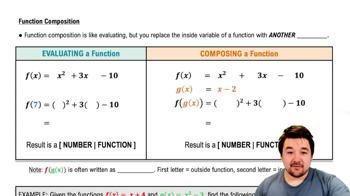
Function Composition

Function composition involves combining two functions to create a new function. If f and g are two functions, the composition (fog)(x) means applying g first and then applying f to the result, expressed as f(g(x)). Understanding this concept is crucial for solving problems that require evaluating composite functions.
Recommended video:
4:56
Function Composition

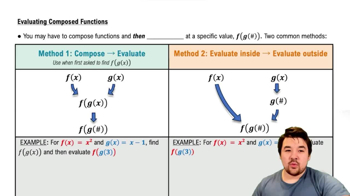
Evaluating Functions

Evaluating functions means substituting a specific input value into a function to find its output. For example, if f(x) = √x, to evaluate f(4), you would calculate √4, which equals 2. This skill is essential for determining the values of composite functions after performing the necessary compositions.
Recommended video:
4:26
Evaluating Composed Functions

Square Root Function

The square root function, denoted as f(x) = √x, returns the non-negative value whose square is x. This function is defined only for non-negative inputs, making it important to consider the domain when evaluating or composing functions that include square roots. Understanding its properties helps in accurately solving problems involving this function.
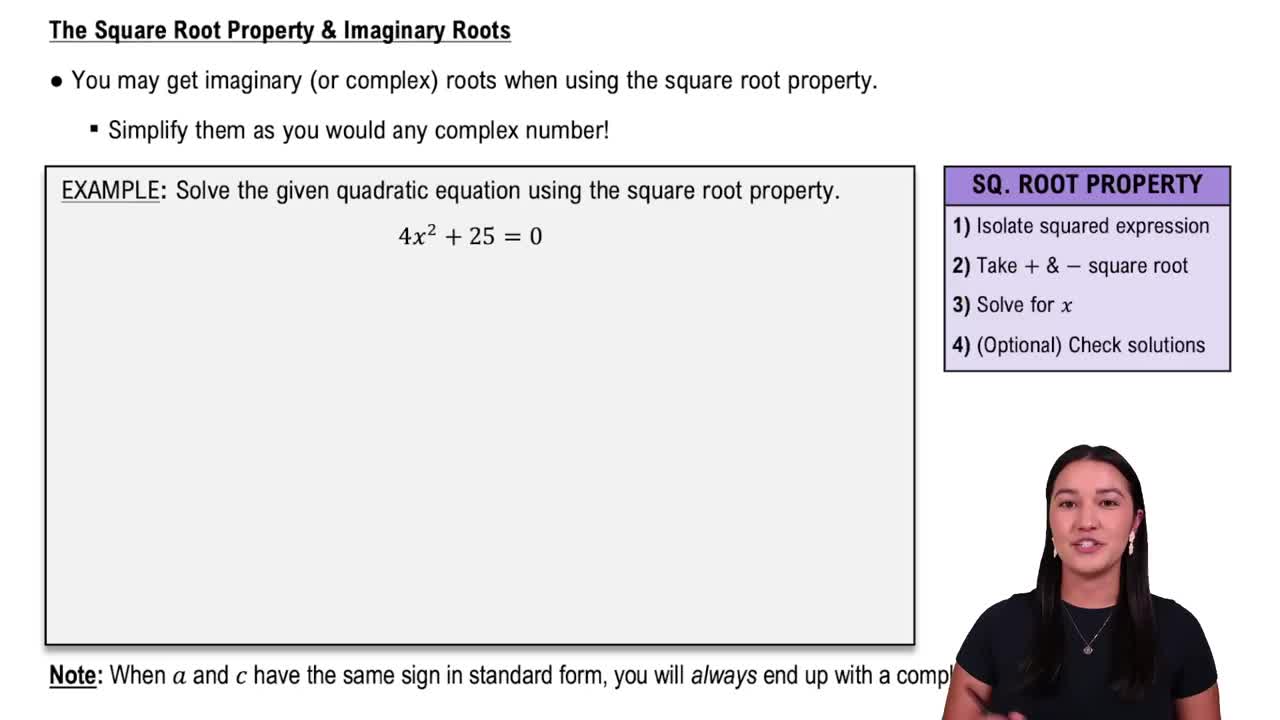
Recommended video:
02:20
Imaginary Roots with the Square Root Property