Ch. 7 - Transcendental Functions
Hass - Thomas' Calculus 15th Edition
Hass15th EditionThomas' CalculusISBN: 9780137616077Not the one you use?Change textbook
Chapter 7, Problem 7.3.65

In Exercises 59–86, find the derivative of y with respect to the given independent variable.
65. y = (cos θ)^(√2)

Verified step by step guidance
1
Identify the function given: \(y = (\cos \theta)^{\sqrt{2}}\). Here, \(y\) is a function of \(\theta\).
Recognize that the function is of the form \(y = [u(\theta)]^n\) where \(u(\theta) = \cos \theta\) and \(n = \sqrt{2}\), a constant exponent.
Apply the general power rule combined with the chain rule for differentiation: \(\frac{dy}{d\theta} = n [u(\theta)]^{n-1} \cdot \frac{du}{d\theta}\).
Calculate the derivative of the inner function: \(\frac{d}{d\theta}(\cos \theta) = -\sin \theta\).
Substitute back into the formula to express the derivative: \(\frac{dy}{d\theta} = \sqrt{2} (\cos \theta)^{\sqrt{2} - 1} (-\sin \theta)\).

Verified video answer for a similar problem:

This video solution was recommended by our tutors as helpful for the problem above.
Video duration:
2m
Was this helpful?

Key Concepts

Here are the essential concepts you must grasp in order to answer the question correctly.

Chain Rule

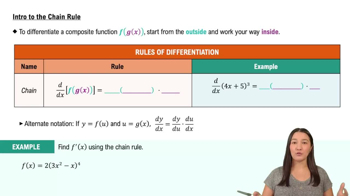
The chain rule is used to differentiate composite functions, where one function is inside another. It states that the derivative of f(g(x)) is f'(g(x)) multiplied by g'(x). In this problem, since y = (cos θ)^(√2) is a composition of the cosine function raised to a power, the chain rule helps differentiate the outer power function and the inner cosine function.
Recommended video:
05:02
Intro to the Chain Rule

Differentiation of Trigonometric Functions

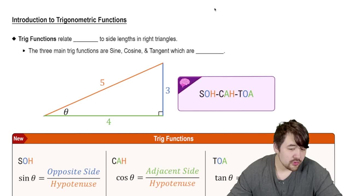
Understanding how to differentiate trigonometric functions like cosine is essential. The derivative of cos θ with respect to θ is -sin θ. This derivative is a key part of applying the chain rule when differentiating expressions involving trigonometric functions.
Recommended video:
6:04
Introduction to Trigonometric Functions

Logarithmic Differentiation

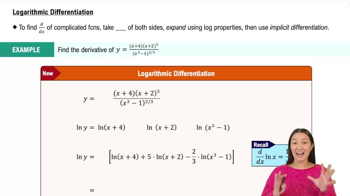
Logarithmic differentiation is useful when differentiating functions with variable exponents, such as (cos θ)^(√2). By taking the natural logarithm of both sides, the exponent can be brought down, simplifying the differentiation process. This technique helps handle powers that are constants or functions.
Recommended video:
06:30
Logarithmic Differentiation